Showing posts with label professional development. Show all posts

Thursday, July 16, 2020

The NEW ALT Training Online Site Is LIVE!


Check out altto.net to experience the ALL NEW ALT Training Online collection of FREE courses.

The needs of ALTs have changed over the past few years. The team here at ALT Training Online has been working hard to keep pace with those changes.
After months of work and thousands of hours put into the new site, it's finally here!
We've heard your feedback and have implemented the changes you've asked for.

The old ALT Training Online website was good, but our new site is even better.

Long pages of text have been replaced by interactive, multimedia courses complete with progress tracking and certificates.

This was made possible by leveraging the power of Moodle to create a genuine MOOC (massive open online course) for language teachers in Japan to sharpen their skills and connect with each other.
As of our relaunch, we have 7 courses available with more on the way.
The blog section is now New and Updates. This is where we'll bring you our monthly guest blogs in addition to other useful information for ALTs.

Our newsletter, The Monthly Trainer, will continue to bring you the latest tips and tricks that you can use in the classroom today.

When the site's founder, Nathaniel Reed, set out to create this website years ago, his goal was to create a place for ALTs who wanted to be better teachers to get the training they so desperately needed.
The ALTTO mission is simple: Connecting and empowering language teachers across Japan.
Our new site brings us ever closer to this goal.

This site is a passion project made by ALTs, for ALTs.

Join us and be a part of the future of teaching English in Japan.

Start studying at ALT Training Online now!

-          A note from ALT training online’s David Hayter


If you have something 'ALT' to write about that hasn't been covered in these blogs, email David at alttoblog@gmail.com so we can work together and spread your story.

Don't have any ideas? We have a list of topics to write about that need a writer. Email in your interest to write and we can set you up.


Never miss another blog again! Click here to sign-up for our newsletter, "The Monthly Trainer," to stay up to date with everything ALTTO has to offer.

Wednesday, May 20, 2020

Working With ALTTO by Nicholas J. Wilson

by Nicholas J. Wilson


Foreward by David L. Hayter: It has been a great pleasure to have Nicholas J. Wilson (or Nick as we call him) join the ALTTO team. 


His time working with our team hasn't been the longest but his impact has been immense. Since he started working with us this year, he has done a lot to support the team by heading up our monthly newsletter, working on the new website, assisting with projects, sharing valuable ideas, giving timely feedback, and implementing new systems to make our work better/easier.

Below is his entry in our "Working With ALT Training Online" blog series. Please join me in welcoming him to the community!

Hi everyone, I’m Nicholas J. Wilson of ALT Training Online. I never had the chance to formally introduce myself so I'll take this opportunity to do so.

I moved to Japan in 2016 and have had since then the lucky chance of working for a great ALT dispatch company (a needle in a haystack!) active specifically in Nagano Prefecture that provides continuous professional development through the year in the form of general training days, in-school workshops and specific one-on-one class observations.

When I started teaching back in 2012, I was in the middle of writing my Master’s Degree thesis and had already received training during the Cambridge CELTA course. While both had given me the necessary skills and knowledge to identify learners' needs, I was still lacking the necessary field experience to successfully apply what I had learned, so the training and suggestions I’ve received from my trainers really did make a difference in transforming me from someone who knew things to someone who could teach things.

During my time (4 years – and counting) working in public schools I’ve had the chance of meeting many other less fortunate ALTs complaining about the lack of training from either their dispatch companies or town’s BOEs.
While some of them weren’t interested in seeking further professional development, many understood their weaknesses and wanted to improve but simply didn’t know how!
The education system is always evolving: teaching in Japan has currently moved towards a student-centered style, putting an end to those never-ending classes where students used to passively listen for hours to their teachers while in fact daydreaming.

Recent changes brought by the Japanese Ministry of Education (MEXT), one of them being recognizing English as a real subject, requires HRTs and ALTs to engage the classroom in what’s called TEAM TEACHING, a practice that involves working together by planning, discussing contents and then teaching accordingly in synergy, constantly switching roles throughout each lesson according to who would be better suited to support or lead specific activities.

In light of this, many BOEs have recently updated their guidelines for hiring ALTs and are now looking for candidates who can understand Japanese classroom dynamics like never before, thus putting an end to the idea that ALTs are just “tape recorders” or “dancing monkeys”.
Unfortunately, the lack of funds and training resources many dispatch companies and BOEs suffer from prevents them from providing new teachers with the necessary knowledge to succeed in the classroom.
The consequences are dire: in a country where ALTs grow in numbers but not in quality, students are the unfortunate victims, losing years of potential education that might have changed their approach towards the world, cutting their chances to succeed in a global society.
Our mission with the ALT Training Online project is to empower ALTs by providing the necessary set of skills many can’t access and create an equal starting point for all teachers in the country with the ultimate goal of ensuring that all children in the country can receive the same level of high-quality English instruction whatever the school, whoever the teacher.
My role in ALTTO involves powering up the platform in order to meet our users’ needs. The “Monthly Trainer” newsletter service which began in March was only the first step towards a new age for the project.
I'm currently working on the new website, an evolution towards a more user-friendly interface which will definitely make things easier to find. Then there's another secret project which will really make the difference. So stay tuned for more!

-          A note from ALT training online’s David Hayter


If you have something 'ALT' to write about that hasn't been covered in these blogs, email me at alttoblog@gmail.com so we can work together and spread your story.

Don't have any ideas? We have a list of topics to write about that need a writer. Email in your interest to write and we can set you up.


Never miss another blog again! Click here to sign-up for our newsletter, "The Monthly Trainer," to stay up to date with everything ALTTO has to offer.

Thursday, April 30, 2020

Professional Development For ALTs by David L. Hayter

by David L. Hayter

Bio: David L. Hayter is a teacher and freelance writer based out of Ho Chi Minh City, Vietnam.

He first gained experience in education by working as an Assistant Language Teacher (ALT) in Japan from 2014-2019. Although he primarily taught junior high school, he has taught all the grades from kindergarten through ninth grade.


During his time as an ALT, he worked in 11 junior high schools, 2 elementary schools, dozens of kindergartens with hundreds of Japanese teachers of English (JTEs) to teach thousands of students.

Aside from teaching, his other duties included training and managing new ALTs, designing and delivering teacher training workshops, and performing other duties for his local Board of Education (BOE).

Outside of work, he actively volunteers in his community, enjoys playing video games, loves to cook, trains hard, is working on a new podcast/blog, and helps run the ALT Training Online blog.
Why do ALTs need professional development (PD)? I guess the answer to that question depends on what you want to get out of being a teacher in Japan.
ALT Training Online actually started to address this need. The type of training and ongoing PD ALTs receive varies from placement to placement. (ESID, right?)
The Cambridge Dictionary defines professional development (PD) as, "Training that is given to managers and people working in professions to increase their knowledge and skills."
If you're going to pursue teaching as a long-time career, you most definitely would benefit from on-going professional development.

Even if you came to Japan looking to explore a new country in between graduate school or a job that's more aligned in your field, you could still benefit from sharpening some of those transferrable skills.
While the focus of professional development should be enhancing your ability to perform your current position, there are a few extra things that you get out of it regardless of your future job prospects.

Benefits of PD

1. Stand out from your peers

Most ALT contracts have an end. These contracts also tend to end around the same time every year (either March or July). That means that when you're going to start looking for a new job, there could potentially be a couple thousand other people doing the same thing!
A 2018 study from Ladders, Inc. shows that hiring managers spend on average 7.4 seconds looking at a resume.
It might seem trivial, but having a few more, or different, bullet points on your resume could mean the difference between starting a new job on Monday or heading off to your zannen-kai.

2. Build transferrable skills

You can lose material things but nobody can take away what you've learned.

Although you may be planning on entering a field other than education, most PD requires organization, writing, communication, and many other skills.

3. Show initiative

No matter where you work, employers are looking for people who can get things done without being told to do so.

Learning new things on your own shows that you have the initiative to do the best job you can and the passion to pursue it.

4. Networking

Chances are that there are other people participating in the same PD program that you are. While you may not also have direct interaction with others depending on the course, there certainly is a community of other like-minded individuals who are either have completed or are currently taking the same course.

Connecting with them is a good way to discuss the course, your industry, and make new friends!
This can go a long way to helping you build up your professional learning network and could lead to more job opportunities in the future.
5. Gain experience

One of the toughest parts about getting a job is that employers want to hire someone with experience. But you can't get experience until someone hires you!

Having some type of training in a certain area is better than having zero experience. Taking courses that involve some type of performance task (like teaching a sample class) can give you a boost of confidence when you go for the job interview.

Another good way to gain experience is by volunteering.

PD Opportunities

1. ALT Training Online

If you're reading this blog, then you must have some interest in teaching English in Japan and improving your skills. The ALTTO website has modules designed to make good teachers great teachers. Best of all, it's free!

Aside from completing our modules, you can also join our team and help out!

If you're interested in what ALTTO has to offer, be sure to sign up for our newsletter and join our Facebook group.

2. Google Certified Educator

The course created by Google teaches educators the basics of using Google in the classroom.

Although you may already know a lot about how to use Google, it's always good to get a refresher on the powerful tools Google has to offer.

There are multiple levels to the program and you can even become certified as a trainer. Lots of employers in Japan love certificates so it couldn't hurt to have another one!

Improving your skills in using Google tools can also help you get jobs outside of teaching.

You can take the course for free and pay when you're ready to take the test. Right now, the fee for taking the level 1 certification test is $10 USD.

3. JLPT

If you're going to be in Japan for a long time, having a high level of Japanese will make your life A LOT easier.

The most widely accepted way to show your Japanese ability to potential employers is through earning a certificate for passing the Japanese Language Proficiency Test (JLPT).

There are many companies and schools that would rather hire someone who has limited experience teaching and speaks Japanese well over someone who has been teaching for years but wouldn't be able to communicate with their staff.

There are tons of resources available online to help you study Japanese to pass these tests.

This can also be helpful if you're planning to move into another industry in Japan.

Most employers want someone with at least an N2 level.

4. TEFL

Obtaining a Teaching English as a Foreign Language (TEFL) Certificate is a great place to start a teaching career.

Accredited courses cover the basics of how to start teaching including methodology, classroom management, and lesson planning. This can be a good way to get ready to start teaching or a way to get better at what you're already doing.

Aside from learning how to teach, some countries (like Vietnam for example), require a TEFL certificate to get a work permit so you can legally work as an English teacher!

This certificate can also help you get better teaching jobs because it shows that you're committed to the profession enough to continue learning about how to do it.

There are other types of certificates like TESOL (Teaching English to Speakers of Other Langues) and CELTA. Most employers treat these as equivalent certifications. Just make sure that whatever course you take is 120+ hours! Many schools won't accept it if it's not.

There are a lot of options for obtaining a TEFL including 100% online classes, in-person classes, and hybrid classes.

If you're interested in a TEFL course, here's a message from Philip Shigeo Brown. He runs the iTDi TESOL Certificate Course at iTDi and is a long-time friend of ALTTO's founder:


🔸 Explore learning and teaching in The Teachers' Room, the iTDi Blog, and iTDi Facebook page.🔸 Learn and grow with the iTDi Community wherever you go and however far you progress in your career.
🔸 
Take an iTDi TESOL Certificate or Advanced Skills course online with like-minded professionals and leaders in ELT.

iTDi is FREE to join and you can sign up easily via our website: https://itdi.pro/
There are many different professional development paths and opportunities for you to take.

Like us, we invite you to invest in your future ...

✅ better job opportunities
✅ better classroom experiences, and
✅ a better sense of fulfillment as a teacher!

And exclusively for ALTTO members, we're offering 10% off iTDi TESOL Certificate courses. (For each sign-up, ALTTO will also receive a small commission and all proceeds go to help pay for the ALTTO site hosting which is entirely run by volunteers!)

Secondly, we've extended our 50% off all iTDi Advanced Skills Self Study courses with coupon code ALTTO50 until May 31st!
(So feel free to stock up since courses can be taken anytime before December 31st next year)!


So, if you'd like to find out more, check us out, get in touch, and feel free to join us anytime in The Teachers' Room!

All the very best!

Phil


-          A note from ALT training online’s David Hayter


Never miss another blog again! Click here to sign-up for our newsletter, "The Monthly Trainer," to stay up to date with everything ALTTO has to offer.


If you have something 'ALT' to write about that hasn't been covered in these blogs, email me at alttoblog@gmail.com so we can work together and spread your story.

Don't have any ideas? We have a list of topics to write about that need a writer. Email in your interest to write and we can set you up. 

For upcoming blogs see the blogs tab here:  http://www.alttrainingonline.com/blog.html

Friday, March 20, 2020

End Of ALT Training Online? by Nathaniel Reed

by Nathaniel Reed

Bio: Nathaniel Reed started his ALT journey in 2014. He was mid writing a dissertation for an MA in Linguistics and it struck him that there was no training for this new job. Even low-level jobs have some kind of training to help you do the job effectively, and teachers are dealing with people’s lives.

These thoughts gave birth to ALT Training Online (ALTTO). 

Quickly realising that ALT pay is the same as when the current ALT system started in 1987, he knew that this training must be free. Thankfully there are a lot of helpful souls in the world, even the leading scholars on language education in Japan, so piece by piece it started to build - this blog will take you on the journey so we'll stop there for now.

With a house and two incredible children, every day is full of surprises and happiness for Nathaniel. We are all on a journey though, growing and evolving who we are on a daily basis.

Let today guide your thoughts in some way to be thankful. Who knows, you may even feel like joining the ALTTO team and improving the quality of what we’re doing. It would be great to hear from you.

Around 6 years have passed since the birth of ALT Training Online. After writing an MA dissertation on the roles of ALTs I couldn't help but let go of the burning question: why didn't I receive any teacher training (pre- or in-service?) when I got the ALT job?

With no coding or web development skills, but an ambition to provide high-quality, free training to thousands of ALTs, my mission began.
Alas, hundreds of dollars out of pocket and many aspects of the site needing an update I face a crossroads – redesign it completely or let the thousands of weekly users down. 
It's quite a size now, there’s a lot of content, so the work would take a while….
On an ALT's salary with a mortgage and two children, the decision should be quite simple, but I'm really struggling with the choice.

I’d hate my own children to go to school and get a low-quality education because the teacher wasn’t trained.

The emails ALTTO receives from individuals in need of help and all the positive comments we get have been on my mind for over a year…...
Unfortunately though, it's adios to ALTTO and ALTopedia….


Just kidding!
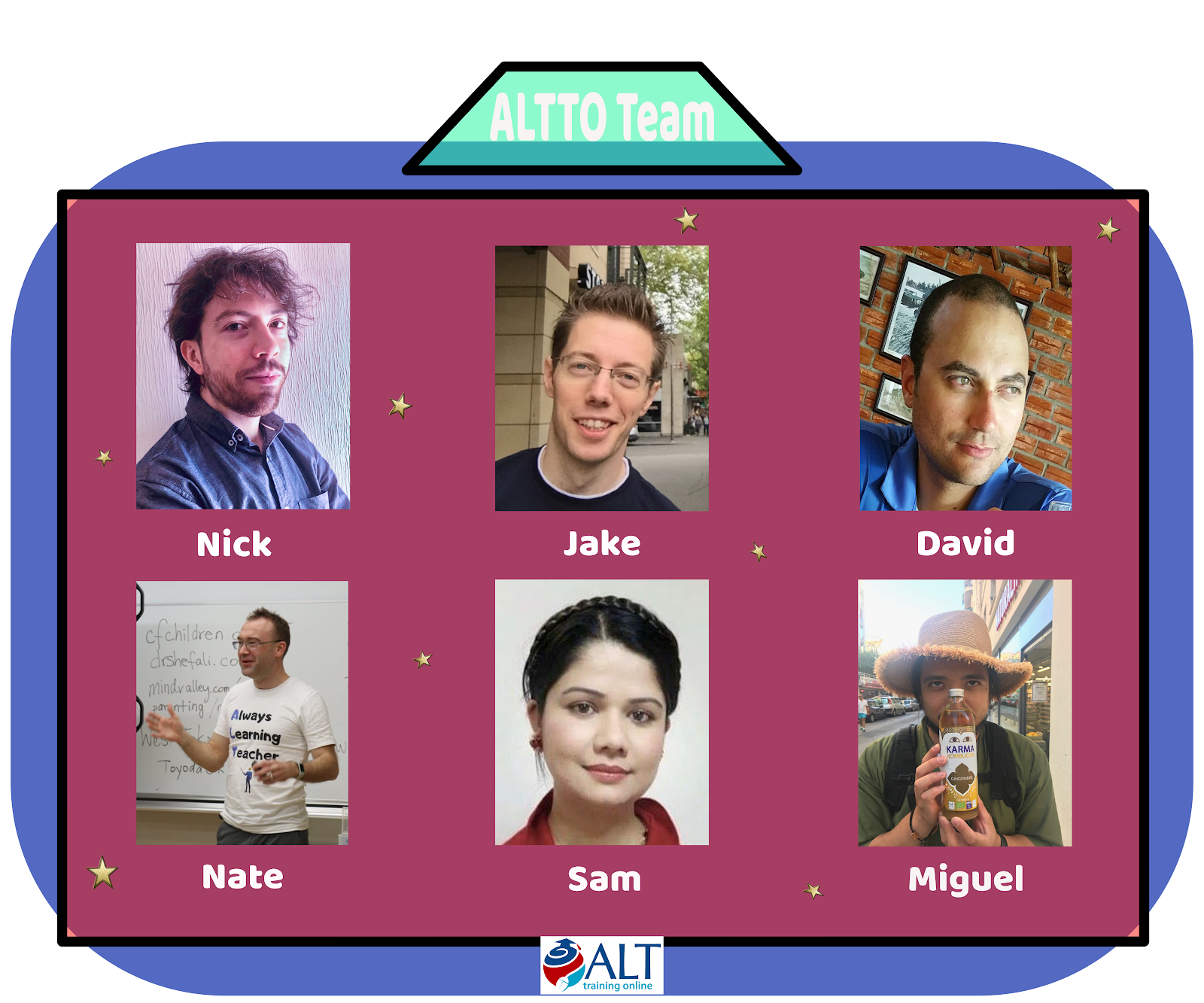
I've been learning to code and the ALTTO team is growing - so the site is getting a makeover!
New features are in place and we're launching two new modules: ‘Vocabulary’ by Dr David Coulson at Ritsumeikan University and ‘Speaking’ by Richard Graham from Genki English – but this is just the start.

David Hayter is as motivated as ever to keep the wide-ranging guest blogs coming – from Vietnam.

Jake (an established coder) is excelling on the ALTopedia resources site, keeping it maintained and arduously updating resources everyday.
We've new affiliations too, and are being advertised outside of Japan with our new partners, including JET (big thanks to all of them).
The big news……(drum roll)….. is the latest member of the ALTTO team, Nick. He's been working incredibly hard to prepare 'The Monthly Trainer'; an email newsletter that’s just the right length with content covering all areas of the ALT world: what's coming up in your schools, teaching tips, teaching English in English….. one of the major changes the Course of Studies schools are sent is requesting from April 2020 - the timing of The Monthly Trainer couldn't be more perfect.

We're working hard to launch the new site sometime in April – so check our Facebook group for the new link: https://www.facebook.com/groups/alttrainingonline/

Sign up right now for The Weekly Trainer, (first edition end of March 2020): https://mailchi.mp/4150701561cf/altto

Join us and make ALT lives better.
You’re still here - great. Read on...
You may know that online courses (in general) have a completion rate of around 10% according to most studies. You may have started one or a tonne of courses online yourself (I’m working my way through 4 at the moment). The ALTTO course/website is no different, although some modules are getting 100% completion rates, interest leaves some users with completion rates of around 20%.
We’ve listened to your feedback, re-reviewed the practice of learning online and have completely changed how the free ALT training course looks - how you the user can develop skills to use in the classroom, whatever your learning style.
It’s much more interactive now. Not just long texts to read with reflection questions - modules are made up of shorter units, a range of media is used, plus interactive features and various questions styles are used to make being an ALT much more enjoyable.

We’re updating the modules too. The three previous categories: Contextual, Teaching and Professional Development are being expanded!

We’re also taking away unpopular modules that didn’t seem to fit people’s interests. We’ve listened to and taken on board suggestions, and then searched far and wide for writers.
We know that the resulting new modules, and whole new course, will deliver exactly what you want and need to make not just make you more confident and better teachers, but also dramatically enhance the potential of your students. 
How would you make ALTTO and Altopedia better? Join the team and make it happen!

-          A note from ALT training online’s David Hayter


Never miss another blog again! Click here to sign-up for our newsletter, "The Monthly Trainer," to stay up to date with everything ALTTO has to offer.


If you have something 'ALT' to write about that hasn't been covered in these blogs, email me at alttoblog@gmail.com so we can work together and spread your story.

Don't have any ideas? We have a list of topics to write about that need a writer. Email in your interest to write and we can set you up. 

For upcoming blogs see the blogs tab here:  http://www.alttrainingonline.com/blog.html

Thursday, February 6, 2020

Working With ALTTO by Steven MacWhinnie

by Steven MacWhinnie

Bio: Steven MacWhinnie is a lecturer at Hirosaki Gakuin University and a doctoral candidate at the University of Leicester. 

He has been living and working in Aomori since 2007, first on the JET Programme, then as an Eikaiwa school owner and part-time university lecturer.

His research interests include motivation, engagement, and language awareness. He has published articles on motivation and engagement and is now working on understanding how students use language in the completion of tasks.

I have been helping with proofreading for ALTTO since 2017. Although at that point I was no longer an ALT, I was curious about what ALTTO had to offer.
Back when I first came to Japan to teach as an ALT, there was nothing in the way of solid training.
ALTs were generally left to sink or swim, local BOEs might provide training of some sort, but generally, there wasn’t much in the way of support. I was excited to see that ALLTO was planning on developing modules that would support ALTs new to Japan.

I’d like to elaborate a bit on why I decided to offer to help with proofreading the modules. Back in 2007 when I first arrived in Japan, even the orientation conference in Tokyo didn’t provide much information on what was actually expected of ALTs.
The little information that was given was mostly focused on telling ALTs to not get into trouble. There was no real education on being an educator.
Looking back at my own experience as an ALT, I can’t say I was particularly good when I first arrived. I was very lucky to have worked with some talented JTEs who took the time to teach me how to be a teacher. I was lucky to be able to understand Japanese and be willing to adjust my teaching style as I learned new things about teaching.
ALTTO now has modules providing in-depth detail about different aspects of teaching, what I spent nearly 3 years learning by trial and error is now readable in a few hours.
While my own experiences are rather different (I worked in a rural area), the module on what to expect and how a typical day might go would have been useful information to have when I started.

As I worked for 5 years as an ALT, I saw many ALTs come and go, and I listened to what the JTEs had to say. Even now, I have friends who are JTEs and they often bemoan the lack of education for new ALTs who come to Japan. While I can’t directly speak to the situation now as I am not longer working as an ALT, I remember that many people came to Japan to work as ALTs more as a way to see the world and they weren’t particularly interested in developing their skills as teachers.

I doubt that the situation has changed significantly, but I do know that for the ALTs who come to Japan and want to be more than a tape-recorder and actually teach, ALTTO provides a lot of important resources for those individuals. A friend at the BOE has often commented that the ALTs who come really need more training resources.
Even the ALTs who seem interested in developing themselves as teachers, don’t have access to good training tools.
Even very basic information is lacking. For example, a new ALT went to visit an elementary school. He was asked to teach the alphabet. In the US at least, most would start by showing a picture of an apple, and saying a /æ/ apple. This isn’t wrong, but it only served to confuse the children in the class who were using a different system, learning a as in ant (ɛənt). This simply goes to illustrate the severe lack of training for new ALTs who arrive in Japan.

As I said above, I am no longer an ALT. This might raise the question of why I still decided to volunteer to be a proofreader for the ALTTO project. I work now as a university educator, partly in the training of English teachers. I also worry about the skill level of incoming freshmen students. I am a long-term resident of Japan and I care very deeply about developing not only the English skills but the global sensibility of Japanese students.

Part of that process is by providing students with competent educators who are knowledgeable and able to impart that knowledge.
If ALTs are effective teachers, I suspect that students will become not only better at the English language but see the value in English as a global means of communication.
For these, among other, reasons I am happy to volunteer my time to try and help this excellent project succeed. The only way forward is through more education, both for ALTs and for their students.

-          A note from ALT training online’s David Hayter


If you have something 'ALT' to write about that hasn't been covered in these blogs, email me at alttoblog@gmail.com so we can work together and spread your story.

Don't have any ideas? We have a list of topics to write about that need a writer. Email in your interest to write and we can set you up. 

For upcoming blogs see the blogs tab here:  http://www.alttrainingonline.com/blog.html

Thursday, January 30, 2020

Working With ALTTO by David L. Hayter

by David L. Hayter

Bio: David L. Hayter is a teacher and freelance writer based out of Ho Chi Minh City, Vietnam.

He first gained experience in education by working as an Assistant Language Teacher (ALT) in Japan from 2014-2019. Although he primarily taught junior high school, he has taught all the grades from kindergarten through ninth grade.

During his time as an ALT, he worked in 11 junior high schools, 2 elementary schools, dozens of kindergartens with hundreds of Japanese teachers of English (JTEs) to teach thousands of students.

Aside from teaching, his other duties included training and managing new ALTs, designing and delivering teacher training workshops, and performing other duties for his local Board of Education (BOE).

Outside of work, he actively volunteers in his community, enjoys playing video games, loves to cook, trains hard, is working on a new podcast/blog, and helps run the ALT Training Online blog.


Working with ALT Training Online (ALTTO) has been one of the most positive experiences in my life, both personally and professionally. The skills I have gained and the relationships that came from it have helped me tremendously.

The first time I came across ALTTO a few years ago was completely by accident. The board of education I was working for provides one month of in-house training every August for new ALTs. As veteran ALTs re-contract throughout the years, they are expected to teach the newly arrived ALTs how to teach in Japan (it's easy, right?).
A simple Google search for "ALT training" led me to the site and my mind was blown. It was like finding cheat codes for a game!
This was the first time I had come across a website dedicated to making ALTs in Japan better teachers. Best of all, there was no charge for any of the information!
What really drew me to the site is that it was made for ALTs, by ALTs.
These weren't articles published for journals or posts about the struggles of one ALT. It was a systematic plan for what ALTs need to know in order to do their job well made by a community.

The site covered a lot of information and had opinions/information from many different teachers. The modules are also backed up with extensive research for those who really want to do a deep dive into ALTing.
Other sites and resources dealing with education and teacher training in Japan usually had some other kind of angle. This wasn't the case with ALTTO.
To me, it seemed like other sites affiliated with the government were trying to portray teaching in Japan in a certain light. Other private sites were more focused on trying to sell a product/service.
After pouring over the site for a few hours, I noticed that there was a call for proofreaders.
I was getting into blogging and writing so I figured this would be a good way to help the cause, become a better teacher, and gain some transferrable skills all at the same time!

Initially, I offered to be a proofreader. After getting in contact with Nate (the founder of the site), he asked if I would like to take over the blog part of the site. He saw the work I was doing on my own blog and thought I could help out. This eventually led to me helping with other areas of the site like social media.
My work with ALTTO has led to opportunities to write for education blogs, be a guest on podcasts, and interact with professionals all over the world.
Although my time teaching in Japan has come to an end, the things I've learned working with ALTTO continue to help me for the rest of my life.
Companies and schools are looking for workers who are not only good at their job but are also skilled in collaboration using technology.
While my main motivation for helping with the site was to improve teacher training and education in Japan, it's very true that this kind of experience does look GREAT on a resume.

Looking back over the past years, I never thought something I started doing during my downtime in October of 2017 would turn into a community of ALTs making a difference in Japan and across the world.
In closing, I'd like to give a big thank you to Nate, the team at ALTTO, all of our blog contributors, our readers, and everyone involved in the ALTTO community. Our work wouldn't be what it is without you!
-          A note from ALT training online’s David Hayter


If you have something 'ALT' to write about that hasn't been covered in these blogs, email me at alttoblog@gmail.com so we can work together and spread your story.

Don't have any ideas? We have a list of topics to write about that need a writer. Email in your interest to write and we can set you up. 

For upcoming blogs see the blogs tab here:  http://www.alttrainingonline.com/blog.html

Wednesday, July 31, 2019

Life After ALT: 11 Skills ALTs Can Develop To Help You Land Your Next Job by David L. Hayter


by David L. Hayter

Bio: David L. Hayter worked as an Assistant Language Teacher (ALT) in Japan from 2014-2019. Although he primarily taught junior high school, he has taught all the grades from kindergarten through ninth grade. During his time as an ALT, he worked in 11 junior high schools, 2 elementary schools, dozens of kindergartens with hundreds of JTEs to teach thousands of students.

Aside from teaching classes in junior high school, his other duties included training and managing new ALTs, designing and delivering teacher training workshops, and performing other duties for his local Board of Education (BOE).

After his career as an ALT came to an end, he started working as a freelance writer and entrepreneur.


Outside of work, he actively volunteers in his community, enjoys playing video games, loves to cook, trains hard, podcasts, helps run the ALT Training Online blog and writes for his blog, Yokkaichi Connections.


For a lot of ALTs, our lives are only as good as our last contract. Although some ALTs have decided to make Japan their home, there are a lot of us who will, eventually, move on to another career in another country other than Japan.
There are too many stories of ALTs who spent years working in Japan only to struggle with finding work once their days as an ALT are numbered.
So many ALTs are caught up in the honeymoon of moving to Japan and starting to work that they often forget about what's going to come after.

When I first started blogging, it was to help new ALTs get more information. One of my first posts was what to do before coming to Japan. Last year, I wrote a blog post about 5 skills you can develop as an ALT to help with your future employment.

Since I just finished up my own stint as an ALT for 5 years, I figured it was a good time to revisit some of the skills I've learned while working as an ALT, volunteering in the community, and helping out with ALT Training Online. Maybe these are some skills that newer ALTs will want to pick up too!

Flexibility

Almost everyone knows the old ALT mantra of "ESID" (every situation is different). After teaching in a variety of schools with different teachers and students, I can say that it's very true. Each teacher has their own way of teaching. Every class has its own attitude, strengths, and weaknesses.
To be a successful ALT, you have to be adaptable and flexible. That means that you have to be able to look at the atmosphere in the class and adjust your teaching plan accordingly.
Sometimes your lessons may be too hard or too easy. You might be really excited about the content of your lesson and nobody else is. Something you thought was going to be really boring might end up being a big hit.
By watching reactions and changing things up, you'll be sure to have great lessons.
Time Management

When it comes to the daily schedule of the ALT, we sometimes can get a lot of downtime. If you're spending those free hours becoming a better teacher on alttrainingonline.com, then you're already many steps ahead of the game!
Depending on the school I was working in, I sometimes had too much free time or not enough. In either situation, the ability to manage my time effectively really helped me get a lot done.
By paying attention to what I needed to get done and how long it takes, I was able to plan out my day and make sure I handled everything I needed to without too much stress.

This skill is especially handy for anyone going into a management-related field. Let's face it, if you can't manage your own time, you definitely can't manage someone else's!

Planning Ahead

I have to admit that as a college student, I was the master of winging it. I would usually do just enough work to get what I needed to get done at the last possible moment. My work was still pretty good, but it would have been A LOT better (and less stressful for me) if I had gotten an early start and made a plan.
Similar to time management, planning ahead is an essential skill for ALTs, especially for projects and classes that will be taught in succession.
This can be tough for us though as a lot of what we teach can depend on teachers that may, or may not, know what they are doing for their next class.

Either way, if you take care of everything you're supposed to, you can't say that any problems that arise were caused by you.

Communication

This is perhaps one of the most important skills an ALT can develop. Since ALTs often work with other teachers, the ability to community clearly and in a short time are essential to getting a lot done in a short amount of time.

This can also be tough given the schedules of the JTEs and language abilities of ALTs and JTEs (this will become even more troublesome with the addition of elementary school teachers to the English teaching equation).
When it comes to having good communication as an ALT, it's important to start early, be proactive, and put the ball in the JTE's court.
If you don't communicate enough, you may seem uninterested or anti-social. If you try to talk with your JTE too much, you can come off as demanding or needy.
I would usually start with an email or a written note. If I didn't get a response, I'd just go talk to the teacher when I saw them around the school (it usually helps to start with small talk before you get to the business of lesson planning).
Whatever form of communication you use, it's important to be clear and succinct.
If you come from a place of supporting the JTE and the students, you'll really be appreciated by the school you are teaching in.

Collaboration

In ALT life, there are plenty of opportunities for collaboration. You can work with your JTEs and students in the school to complete projects that can't be done alone.
There is also a large community of ALTs out there working on all sorts of projects on-line and in professional groups
Aside from building your professional learning network, belonging to groups looks GREAT on your resume.
If you're looking for opportunities to work with some great ALTs while picking up some knowledge and skills along the way, be sure to check out these groups:
That's about all I could think of off the top of my head. Do you know about other groups? Let us know what they are in our Facebook group.

Social Media Marketing

A few years ago, I came across ALT Training Online while researching ALT training for some new ALTs we were getting in August. Little did I know that volunteering to proofread new modules for the course would turn into the opportunity to run the blog for the site and help with our social media promotion.
Social media marketing is becoming a very in-demand skill for a lot of companies. There are even more opportunities to work remotely and on a part-time basis for clients.
This can become a nice full-time gig or even a side hustle to help supplement your teaching income.

Graphic Design

Along with social media marketing, the rise of internet marketing and the sheer amount of content that's pumped out online every day has created a HUGE demand for eye-catching graphics and well-designed websites.
Most schools (hopefully) have access to a computer. There are a lot of free programs you can use to produce quality graphics for your lessons and other projects.
Whether it's making yourself Batman (like I've done numerous times) or creating a version of Momotaro where he pops out of a Cup Noodle (something I've done once), the students really get a kick out of seeing what you can do with a computer.
The same work you would put into making a worksheet for your class could easily be transferred into layout design for a magazine or poster.
Remember that Google is your friend. The answer for how to do anything you want on almost any program is only a search away!

Writing

Although most teachers want ALTs to focus on speaking and listening skills in our classes, a good writing class can really help your students increase their English ability.
By writing samples for your class, you have a chance to hone your writing abilities.
Don't get me wrong, the English you'll probably write for your students will be simple, but then that's the challenge!

Writing for companies that produce non-academic content can be very lucrative. You can also take a chance and try to get creative with some of your writing for class. If the students and teachers see what you can come up with, it might inspire them to go a little bit more out of the box than usual.

As an ALT, you can also get some experience blogging. I run this blog in addition to my other blog, Yokkaichi Connections.
Aside from building skills, the things your write online can help serve as a portfolio of your work and get you noticed by potential employers.
Translation/Interpretation

If you've got the Japanese skills, you can make a decent living doing translations for a variety of clients. When I was an ALT, my BOE would often have some documents from City Hall that needed to be translated. Those of us who would read Japanese would help translate forms and letters from Japanese to English and vice versa.
If you want to volunteer, there are also opportunities to work community groups that serve as local tour guides, help people who don't speak Japanese, and promote local attractions.
If you can build a reputation as a reliable translator/interpreter, you'll be able to open up doors that otherwise wouldn't be available to you.

Presentation

When you think about it, teaching something is pretty much giving a presentation (although it's hopefully a little more interactive and interesting than your usual college PowerPoint).
The way you speak, your volume, diction, vocabulary choice, pace, questions, and timing all really add up to either making a great experience or one that's lackluster.
If you can reflect on your performance and how you can improve, you'll become really good at presentations and super comfortable talking in front of crowds.

Web Design

This is another skill that people are willing to pay big bucks for. If you can make a slick website for a person or a company, you can find a lot of work.
Even if you plan on being a teacher, your ability to help out with the school's website may be the difference between your getting hired or someone else.
The days of having to be a coder to make a website are over (although it does help). Almost anyone can do it, but it takes practice to do it well.

If your school has a computer club, this is something else you can do together. You could even use making a website as a group project for your students if you have access to computers.


-          A note from ALT training online’s David Hayter


If you have something 'ALT' to write about that hasn't been covered in these blogs, email me at alttoblog@gmail.com so we can work together and spread your story.

Don't have any ideas? We have a list of topics to write about that need a writer. Email in your interest to write and we can set you up. 

For upcoming blogs see the blogs tab here:  http://www.alttrainingonline.com/blog.html