Showing posts with label English in Japan. Show all posts

Friday, March 20, 2020

End Of ALT Training Online? by Nathaniel Reed

by Nathaniel Reed

Bio: Nathaniel Reed started his ALT journey in 2014. He was mid writing a dissertation for an MA in Linguistics and it struck him that there was no training for this new job. Even low-level jobs have some kind of training to help you do the job effectively, and teachers are dealing with people’s lives.

These thoughts gave birth to ALT Training Online (ALTTO). 

Quickly realising that ALT pay is the same as when the current ALT system started in 1987, he knew that this training must be free. Thankfully there are a lot of helpful souls in the world, even the leading scholars on language education in Japan, so piece by piece it started to build - this blog will take you on the journey so we'll stop there for now.

With a house and two incredible children, every day is full of surprises and happiness for Nathaniel. We are all on a journey though, growing and evolving who we are on a daily basis.

Let today guide your thoughts in some way to be thankful. Who knows, you may even feel like joining the ALTTO team and improving the quality of what we’re doing. It would be great to hear from you.

Around 6 years have passed since the birth of ALT Training Online. After writing an MA dissertation on the roles of ALTs I couldn't help but let go of the burning question: why didn't I receive any teacher training (pre- or in-service?) when I got the ALT job?

With no coding or web development skills, but an ambition to provide high-quality, free training to thousands of ALTs, my mission began.
Alas, hundreds of dollars out of pocket and many aspects of the site needing an update I face a crossroads – redesign it completely or let the thousands of weekly users down. 
It's quite a size now, there’s a lot of content, so the work would take a while….
On an ALT's salary with a mortgage and two children, the decision should be quite simple, but I'm really struggling with the choice.

I’d hate my own children to go to school and get a low-quality education because the teacher wasn’t trained.

The emails ALTTO receives from individuals in need of help and all the positive comments we get have been on my mind for over a year…...
Unfortunately though, it's adios to ALTTO and ALTopedia….


Just kidding!
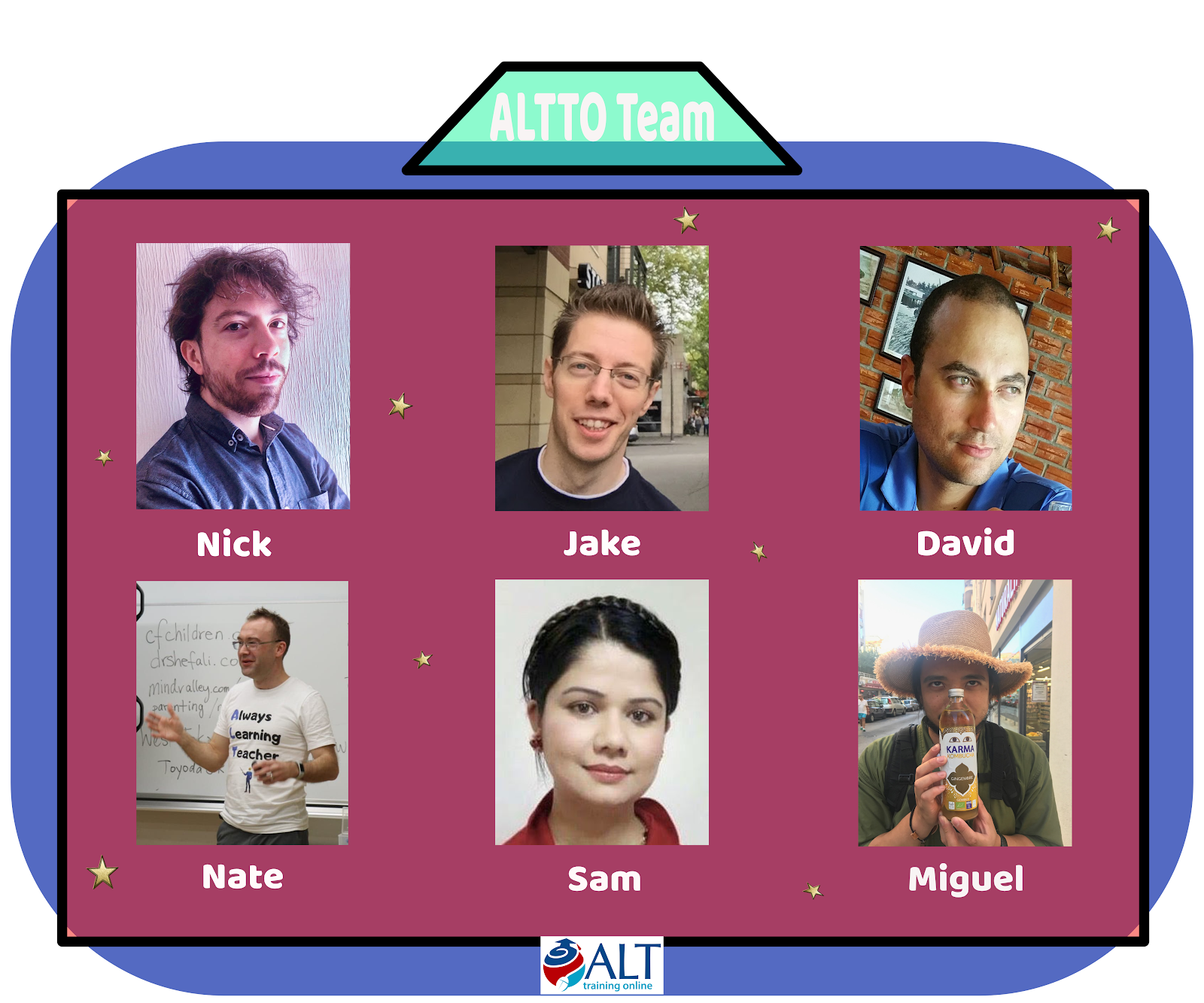
I've been learning to code and the ALTTO team is growing - so the site is getting a makeover!
New features are in place and we're launching two new modules: ‘Vocabulary’ by Dr David Coulson at Ritsumeikan University and ‘Speaking’ by Richard Graham from Genki English – but this is just the start.

David Hayter is as motivated as ever to keep the wide-ranging guest blogs coming – from Vietnam.

Jake (an established coder) is excelling on the ALTopedia resources site, keeping it maintained and arduously updating resources everyday.
We've new affiliations too, and are being advertised outside of Japan with our new partners, including JET (big thanks to all of them).
The big news……(drum roll)….. is the latest member of the ALTTO team, Nick. He's been working incredibly hard to prepare 'The Monthly Trainer'; an email newsletter that’s just the right length with content covering all areas of the ALT world: what's coming up in your schools, teaching tips, teaching English in English….. one of the major changes the Course of Studies schools are sent is requesting from April 2020 - the timing of The Monthly Trainer couldn't be more perfect.

We're working hard to launch the new site sometime in April – so check our Facebook group for the new link: https://www.facebook.com/groups/alttrainingonline/

Sign up right now for The Weekly Trainer, (first edition end of March 2020): https://mailchi.mp/4150701561cf/altto

Join us and make ALT lives better.
You’re still here - great. Read on...
You may know that online courses (in general) have a completion rate of around 10% according to most studies. You may have started one or a tonne of courses online yourself (I’m working my way through 4 at the moment). The ALTTO course/website is no different, although some modules are getting 100% completion rates, interest leaves some users with completion rates of around 20%.
We’ve listened to your feedback, re-reviewed the practice of learning online and have completely changed how the free ALT training course looks - how you the user can develop skills to use in the classroom, whatever your learning style.
It’s much more interactive now. Not just long texts to read with reflection questions - modules are made up of shorter units, a range of media is used, plus interactive features and various questions styles are used to make being an ALT much more enjoyable.

We’re updating the modules too. The three previous categories: Contextual, Teaching and Professional Development are being expanded!

We’re also taking away unpopular modules that didn’t seem to fit people’s interests. We’ve listened to and taken on board suggestions, and then searched far and wide for writers.
We know that the resulting new modules, and whole new course, will deliver exactly what you want and need to make not just make you more confident and better teachers, but also dramatically enhance the potential of your students. 
How would you make ALTTO and Altopedia better? Join the team and make it happen!

-          A note from ALT training online’s David Hayter


Never miss another blog again! Click here to sign-up for our newsletter, "The Monthly Trainer," to stay up to date with everything ALTTO has to offer.


If you have something 'ALT' to write about that hasn't been covered in these blogs, email me at alttoblog@gmail.com so we can work together and spread your story.

Don't have any ideas? We have a list of topics to write about that need a writer. Email in your interest to write and we can set you up. 

For upcoming blogs see the blogs tab here:  http://www.alttrainingonline.com/blog.html

Monday, March 9, 2020

Using Technology To Teach English In Japan by Paul Raine

by Paul Raine

Bio: Paul Raine (MA TEFL/TESL, University of Birmingham 2012) is an award-winning teacher, presenter, author, and developer.

His books include the best-selling 50 Ways to Teach with Technology and the innovative multi-path graded reader Journey to Mars. He has also developed his own website for teachers and learners of EFL (www.apps4efl.com). He has published numerous research articles on the teaching and learning of English as a second language, and is particularly interested in Computer Assisted Language Learning (CALL). 

He currently teaches at two universities in the Tokyo area.

A nation of innovative technophiles or conservative technophobes?

Japan generally seeks to project a highly technologically advanced image on the international stage: bullet trains, capsule hotels, the giants of the video gaming industry, and electronic consumer goods for every conceivable need.

However, anyone who has visited Japan knows that there are two sides to the country: the innovative high-tech side, and the conservative traditionalist side. The latter seems to be especially prominent in the education sector.


The conservative Japanese education sector

As a case in point, when I was working as a dispatch agency teacher at a technology university in Kanagawa in 2008, the person in charge of infrastructure decided that it was a good idea to install blackboards in a brand new wing of the university. Not smartboards. Not whiteboards. Blackboards. As a reminder, blackboards are 19th century technology.

Another case in point. Anyone who has ever ridden on a train in Japan has almost certainly seen Japanese school children learning English vocabulary from books by holding a transparent piece of red plastic (shitajiki) over the page, which can be used to obscure or reveal text written in red ink, and facilitate rote-learning on-the-go.


The right tool for the right job

Now, you may be wondering exactly what is wrong with these techniques? What’s wrong with “chalk and talk”? What’s wrong with “drill and kill”?

There may well be nothing wrong with such traditional teaching and learning techniques used in moderation and in the appropriate circumstances.

And while I’m not going to go into a comprehensive literature review of the relative merits of the traditional versus the high-tech, the important point to be made here is to choose the right tool for the right job.

There are some things that tech-powered tools do better than traditional ones, and some things that can only be done with technology.
When is technology better?

Digital teaching and learning materials can be copied, edited, deleted, transmitted, backed-up, collaborated on, revised, commented on, duplicated, and converted into different formats much more efficiently and easily than traditional paper media.

Of course, some of these benefits also give rise to potential vulnerabilities and drawbacks, including issues of security, which many Japanese educational institutions are notoriously paranoid about.

But there are also many things that can only be done with the use of technology, most notably anything relating to audio or video.
The benefits of using video to teach English have been well documented, and where would the typical English teacher be without their trusty tape-deck / CD-player / MP3-player / audio streaming website?

Tech is the king of task automation

Then of course there is tracking student progress and grading student work.

“Yes! I get to grade fifty exam papers tonight!” said no English teacher ever.

Technology to the rescue. Multiple choice English tests can be easily administered and automatically graded online with Google Forms, and there are a vast plethora of Learner Management Systems (LMS) offering comprehensive solutions to the create, administer, submit, grade, feedback cycle that teachers love so much.

The chances are that your institution already has an LMS, although whether it actually gets used is a whole other matter.
Enabling the cutting edge

So far we have mainly discussed well-established uses of technology for language teaching and learning, but recent advances in Artificial Intelligence (AI) and Machine Learning (ML), have made a whole new range of cutting edge affordances possible.

Automatic Speech Recognition (ASR) systems have paved the way for online Computer Assisted Pronunciation Training (CAPT) solutions, such as EnglishCentral, and Text-To-Speech (TTS) has improved to the point where it is becoming impossible to distinguish computer generated voices from human ones.

Will advances in AI eventually result in ALTs being replaced by blue-eyed blonde-haired English speaking robots? 
Possibly. 
Some schools in Japan are already experimenting with such solutions.
But robots still find it hard to interact with and inspire English learners on a truly human level.

So until the arrival of the singularity, why not adopt more tech-based teaching practices in your classroom? Of course, you will be limited by your institution’s infrastructure and its (often infuriating) technology policies, but there are usually workarounds for such issues.

For more information about how to use technology for teaching English, check out my book. 
You might also want to take a look at my list of over 185 English learning and teaching websites.
-          A note from ALT training online’s David Hayter


Never miss another blog again! Click here to sign-up for our newsletter, "The Monthly Trainer," to stay up to date with everything ALTTO has to offer.


If you have something 'ALT' to write about that hasn't been covered in these blogs, email me at alttoblog@gmail.com so we can work together and spread your story.

Don't have any ideas? We have a list of topics to write about that need a writer. Email in your interest to write and we can set you up. 

For upcoming blogs see the blogs tab here:  http://www.alttrainingonline.com/blog.html

Wednesday, October 23, 2019

From Sage On Stage To Guide On The Side: My Journey As An Educator In Japan by Jason Wolfe

by Jason Wolfe

Bio: Designing a classroom experience centered around creativity and innovation is an exciting topic for this educator with a background in plant ecology and corpus linguistics. 

Jason Wolfe, a Canadian long term Tokyo resident, has taught eikaiwa, high school, and university, and now teaches design full-time and speaks about design thinking.

His volunteering keeps him active in the maker movement, JALT, and TEDxYouth@Tokyo. A collaborator with many groups seeking to provide a much-needed perspective on the future of learning, Jason’s insight into the benefits of tactile explorations inspires the creative problem-solving confidence that will challenge your perspective.

A Little History

I came to Japan in late 2005 and started doing the eikaiwa stuff, GABA mainly, and although I have some issues with the company and how they treat their “non-workers,” I had a positive experience because of all the connections I made there, both personal and professional. 

Over time I found my way into a national high school teaching higher-level English to returnees. This was a nice jump as I was tasked with creating and implementing my own curriculum for the first time.
This was more of teaching something ‘in’ English, instead of teaching English as a language or second language. 
I would later learn proper terms for this, PBL, CLIL, etc.
This was a major high point because previously I'd always had to teach a prepared curriculum and, being who I am, generally had issues with it. I taught what I was interested in, and at the time, it was environmental issues and philosophy.

That school was at the beginning of a transition from a 3 + 3 (junior and senior high school) to a 6-year school, and more importantly, a switch to an International Baccalaureate (IB) school. This is usually done by introducing a cohort on the new plan while the older grades are still in the old system. Every year you add a new cohort as another grade graduates and slowly the school is transitioned. I became part of both schools and there was some learning involved with the IB methodology.

Although the IB program we were teaching, the Middle Years Programme (MYP), was a methodology designed to be implemented with any national or regional curriculum, it was a very different approach. The biggest learning change was assessment. This included rubrics and very clear instructions on what is expected from students to receive a certain grade.

Grading was also organized into four or more criteria with very clear distinctions. In a nutshell, there was much less of “I think this is a 7/10, feels like a 7…” These and other IB related things really opened my eyes to education and what it means to be an educator.

From Sage on Stage to Guide on the Side

From then I started defining what kind of educator I was. I realized I was not really interested in what I thought education was ... students as empty glasses to be filled by the all-knowing teacher.

I wanted to challenge and motivate my students ... create life-long learners (some more IB jargon).

Currently ...

I currently teach Design to junior high school students at a private 6-year high school in downtown Tokyo called Kaichi Nihonbashi Gakuen. This is an IB MYP class and since we follow the national curriculum I had to align my course to the national standards of 技術 (Industrial Arts) and 家庭科 (Home Economics).
Yes, I teach sewing and cooking.
But, I do it in a design thinking sort of way, where I provide problems and challenges and they have to solve them by making something.
Here are a few examples of some problems and solutions:
  • Design a locker shelf that will make the classroom a better learning environment for you and your peers (1st-year JHS wood processing project). Students use SketchUp to 3D design their shelf and planning models then make the real thing.
  • Design a Japanese inspired healthy breakfast cookie (2nd-year JHS nutrition project). Many people skip breakfast and a cookie is a hand-held solution to that problem. But, a cookie is a little strange for breakfast...hence the Japanese culture addition.
  • Design a product that will make elderly people healthier ... using only the parts from an old umbrella! (3rd-year JHS community/society project). There are too many elderly people in Japan (contentious!) and too many umbrellas. Let’s create something that solves both problems.
One thing I try to do as we go from 1st year to 3rd year is to try to make my projects less and less Googleable.
This is to force them to be creative. 
Kids are naturally creative, but in high school they are busy and the whole system seems to reinforce the idea that creativity is not as important as test scores and finals.
If I don't think about forcing creativity, they'll resort to using Google, not due to lack of creativity, but lack of time. The students will Google that project and see what comes up ... I think the idea of giving students something unGoogleable is a must for this generation.

Another task I strive for is radical creativity. As I tweak and update my lessons from year to year I look for areas where creativity can be maximized. This is how I ended up with the challenge to make the elderly healthier using only parts of an old umbrella. Recently I have found that the projects coming back to me are similar and following a trend. I will have to tweak them and possibly allow them to use any waste resource and might even add unGoogleability to the lesson requirements.
When I Google the students' ideas, I want to see nothing in the results.
How can I implement lessons that push for maximum creativity?
A lot of my personal inspiration for creativity comes from the D-School at Stanford. I started following a lot of their steps in my English classes and my science lessons and eventually, I ended up teaching Design. I am very happy with this transition.

Although I teach a little English on the side, my full-time work is as a design teacher - challenging and, hopefully, inspiring students to maximize creativity and prototype like crazy.
The goal is to make quick and dirty solutions to the problem and then iterate and expand.
The language of instruction is English. I teach two classes, the DLC and the GLC class, or the lower and higher English level, respectively. They will study Design for the three years of junior high school.

The goal of the 4-year MYP program at my school is to get their English proficiency up to a level where they can study in an IB Diploma Programme (DP) class in English.

This is a daunting challenge as DP classes are rigorous and challenging. The first year class comes in at a very low-level English and I often have to use some Japanese, provide some bilingual material, and/or have a Japanese teacher assist at times.
Navigating the material at their level is a challenge but the complex nuances of IB assessment is also very complicated (in Japanese too) for their young minds.
Here are some pictures of students working:


Other Responsibilities

The biggest responsibility I have outside of teaching is managing the English book library. The library is a little small and the English books were very few and of limited quality and interest. I have to choose, buy, and process most of the Englsih books.
I love books, but I am not a trained librarian, I had to learn/guess a lot of stuff, and it is a learning process.
There are a few different categories I try to build upon. I make sure to get English books that:
  • Correspond to the taught curriculum in both Japanese and English
  • Inspire a love of reading
  • Should be part of all libraries (I don’t know if anyone will read War and Peace, Marcel Proust, or Adam Smith’s The Wealth of Nations...but they are there as an antilibrary)
  • Facilitate academic research for the end of junior high and senior high school projects
  • Progress students through the extensive reading program
Here is our (English) library
For the extensive reading program, I need to provide materials that will allow for a transition from a basic beginner escalating up to native, or near-native, high school level. We try to do this in 4 years, junior 1 to senior 2. The minimum they need to achieve is CEFR B2 in all 4 skills, but even at that level, the DP course will be quite a challenge.
Another thing my school does and I am directly involved with is native speaker homeroom teachers (HRTs).
I am currently a third-year HRT with the GLC class and have to deal with all the responsibilities that go with that. Parent/Teacher interviews, discipline, dealing with personal issues, fieldwork in another city for 3-4 days, classroom tidiness, and other things.
It is a lot of work but mostly, very enjoyable.
I am now in my 4th year at this school, happy and content, but wondering how to keep adding creativity to my life and where the next changes will happen. I have always found that my favorite age to teach is junior high, but it takes a lot of energy and I am not sure I can do that until retirement (although I could as this position is permanent). Change is approaching...but when, where and what...TBD.

-          A note from ALT training online’s David Hayter


If you have something 'ALT' to write about that hasn't been covered in these blogs, email me at alttoblog@gmail.com so we can work together and spread your story.

Don't have any ideas? We have a list of topics to write about that need a writer. Email in your interest to write and we can set you up. 

For upcoming blogs see the blogs tab here:  http://www.alttrainingonline.com/blog.html

Monday, May 20, 2019

Tips For Teaching Japanese Teenagers And Young Adults by Lina Gordyshevskaya

by Lina Gordyshevskaya

Bio: Lina Gordyshevskaya graduated from the University of Edinburgh in 2015 earning an MA with honors in Scandinavian Studies. She obtained a CELTA in 2016 and Delta Module 1 in 2018.

Throughout her career, she has taught YL (young learners), teenagers, and adults of various levels in different contexts, including conversational schools and universities. Currently, she is teaching Business English at an IT-company in Tokyo and loves her job. She writes regularly for her blog, Side Notes on ELT.


Think of a typical Japanese teenage learner. You have probably come across some of them. Quiet and unresponsive, they never look at you and seem uninterested in whatever is going on in the classroom. All your questions are met with deafening silence. Little by little, you start feeling like you are banging your head against a brick wall until one day you realise that you have had enough.

The worst thing you can do in this case is to be quick to judge and give up on this whole situation. Yes, Japanese students are remarkably silent, but let us look at some reasons behind their silence.

Jim King (2014) stated in his research paper on social anxiety and silent behaviour of Japanese learners that the main reason is their cultural background. He wrote that in Japan, reserved behaviour is ‘culturally acceptable and positively regarded’ (p.234). Japan is a very high-context nation which means that one has to read between the lines. Less is said, but more is meant. The Japanese tend to place a higher positive value on silence in comparison to overt verbalisation (ibid).

Seiko Harumi (2001) added one more explanation. According to her, Japanese students’ use of silence is the result of the pedagogy of foreign language teaching including curriculum design and the methods used in teaching.


Indeed, Japanese classrooms are rather teacher-centred.

Foreign languages are taught starting with grammar and vocabulary, and the emphasis is put on receptive skills rather than productive.

In a country where an individual’s social status and position in the social hierarchy are important, students are seen as subordinates and their role is ‘to listen, observe, and learn’ (Atkinson, in Banks, 2016) and not to express their opinions. Of course, nowadays, this is changing but there is still a long way to go.

Taking into an account the abovementioned reasons, we can say that there are definitely quite a few challenges that foreign teachers are facing when teaching in Japan.

The question is what they can do about it. What can you do about it?


1. Problem: Your students avoid eye contact. When you speak, they often stare at their desks, but they will not look at you.


Comment: Surprisingly, it does not mean they are not listening. Of course, not all of them are paying attention, but many do. They avoid eye contact because, in their culture, the teacher is a superior, and one is not supposed to look openly at their superiors.

Solution: I would say that the only way is to accept it and take it calmly.

2. Problem: You asked your students if they understood your instructions / explanations. They all said yes or nodded but when you told them to start with the task it appeared that some of them did not understand what to do.

Comment: In Japanese culture, there is a concept of honne as opposed to tatemae. Honne is what an individual actually feels and thinks and tatemae is what they show to the public. It is very important that one keeps the face no matter what. Admitting out loud that there is something you did not understand is unacceptable and even humiliating from a Japanese person’s perspective.

Solution: Learn to read their faces. Many students will not say ‘no’ directly, but they will still look a bit confused. If this is the case (i.e. if you see some confused looks on their faces), give instructions / explanations once again but more slowly. You can also ask stronger students to translate your instructions into Japanese for those students who seem lost.

Another option is to learn some basic Japanese. Before starting with the task, those students who do not understand what to do will most likely whisper something like ‘What are we supposed to do? I didn’t understand’ to their neighbours, so you can act on this.


3. Problem: You ask them to share their opinion, and they freeze.

Comment: They want to give the right answer, but they do not know which is right. Giving a wrong answer means to lose your face, so instead of taking a risk they prefer to keep silence and avoid a potentially embarrassing situation. Another reason is that they are not used to expressing their opinions because they have hardly ever been asked to do that before.
Another reason could be that they are afraid of making errors, e.g. using wrong grammar, or they simply cannot find the right words. Many Japanese people have an erroneous belief that they should either speak perfect English or not speak it at all.

Solution: Instead of making them answer your questions directly, ask them to discuss the questions in pairs. You can walk around and comment on some interesting ideas you hear.

After a while when your students get used to this kind of interaction start asking them to report their ideas back to you. At first, they will struggle, but it is easier to repeat something you have already said rather than coming up with an idea on the spot.


After some time you will notice that they need less time before reporting. It took my students roughly seven weeks to get used to it, but eventually, they could do it easily and with little hesitation.

Make sure that you explain clearly that mistakes are okay and that the main idea of communication is mutual understanding rather than linguistic perfection (even if you yourself somewhat disagree with this).

4. Problem: A variation of the previous one, but a more severe one where your students do not want to communicate with each other either.

Solution: Instead of making them speak, why not ask them to write their answers down? Give each student a small whiteboard and a marker and see if it works. After all, communication does not necessarily have to be oral. After a while, when they get used to you and your classes, you can try encouraging them to become more verbal.

5. Problem: Your students smile all the time and seem to be positive, but one day, you overhear that some of them were complaining about your classes.

Comment: Smiling does not mean that they like you and enjoy the lesson. They are just being polite. They are not doing it on purpose - they just do not want to discomfort you. In Japan, people avoid being direct as this might offend other people. However, this does not mean they do not want to give feedback.

Solution: What you can do is to ask them to write down how they feel about today’s class, e.g. what they liked and what they found difficult. My students were quite keen on this and shared many difficulties they experienced. By knowing more about their feelings and learning issues I was able to assist them more effectively.

And once again, learn some Japanese to be able to understand their real attitude from what they say to their classmates.

While all of the above might alarm you, one thing you should know is that after several weeks, your students will get used to you and become more open and relaxed.

They might even start being honest about not understanding something and ask questions.

Just be patient and attentive to their needs, show them that you are sensitive to their fears and difficulties they experience and create a comfortable atmosphere.
Teaching is a rewarding profession, and teaching in Japan might be one of the best experiences in your life. You are the teacher, and everything is in your hands.

References:

Banks, S. (2016). Behind Japanese students’ silence in English classrooms. Accents Asia, 8 (2), pp. 54-57.

Harumi, S. (2001). The use of silence by Japanese EFL learners. JALT Conference proceedings.

King, J. (2014). Fear of true self: Social anxiety and the silent behaviour of Japanese learners of English. In K. Csizér & M. Magid (eds.), The impact of self-concept on language learning. Bristol, England: Multilingual Matters.


-          A note from ALT training online’s David Hayter


If you have something 'ALT' to write about that hasn't been covered in these blogs, email me at alttoblog@gmail.com so we can work together and spread your story.

Don't have any ideas? We have a list of topics to write about that need a writer. Email in your interest to write and we can set you up. 

For upcoming blogs see the blogs tab here:  http://www.alttrainingonline.com/blog.html

Friday, April 19, 2019

Then And Now: Teaching In Japan by Neal Graham

by Neal Graham

Bio: Neal Graham is an ALT from Canada. He first worked in Japan over 20 years ago and later returned to teach here again.He has a BA in English and a CELTA. He also lived in Japan for 5 years in the mid-2000s working in the eikaiwa industry. Before becoming a city ALT, he taught at the university level in Japan.

Foreward: The following is a now-and-then comparison based on my experiences as an ALT. This is not meant to be an absolutely definitive tale of the way it was versus the way it currently is. Rather, it’s just a few casual observations based only on my experience and my situation. There are differences between my employment situations now and then that may have affected my perspective. For example, now I am a direct-hire municipal ALT whereas I was a prefectural-JET ALT many years ago. Other people will have completely different experiences.


I was a prefectural ALT with the JET Program 22 years ago. I stayed in Japan for 2 years and then returned to Canada. A while ago I came back to Japan and now I’m working as a direct-hire city ALT.

A lot has changed in Japanese schools in those two decades.

I could write about the many educational changes that have occurred, but I won’t. Instead, I’ll talk about a few non-educational changes that I’ve witnessed.

Compared to other countries Japan is still a very cash focused country, although this keeps changing bit by bit.

When I first worked as an ALT in the late 90s, I was paid in cash.

Once a month I was handed an envelope filled with money. This surprised me. The school had set up a bank account for me on my first day, and eventually they did change me over to a direct deposit system, but the cash payments continued for a quite a while. Certainly electronic deposits were possible in Japan at that time. I’m not sure if that happens anywhere anymore. My current employer has been depositing my salary directly into my bank account since I was hired.

I remember some Japanese teachers in the school were regularly paid in cash. Was this because they preferred to be paid in cash? Or was it a systematic quirk of my school?

To accommodate all the cash floating around the teachers’ room, a bank representative would come to our school once a week to take care of our banking needs.

Salaries could be deposited, spending money could be withdrawn and other banking transactions could be facilitated. I opened an account at that bank (Oddly, it was a different bank than the one where the school had opened my main account) so that I could do some banking from the convenience of the teachers’ room. Perhaps there are some banks somewhere still offering this service today, but I haven’t seen it.

Another change I’ve experienced involves ALT school assignments. When I was a prefectural ALT in the 90s, each ALT was assigned to only one school.

City ALTs that lived in that prefecture were shared between two Junior High schools. I spent every day at the same school. Every student had a lesson with me at least twice a week. I was able to get to know my fellow teachers and all the students very well. I participated in club activities and all the school events. I attended teachers’ meetings. I was treated as any other teacher at the school.

Now, as a direct hire city ALT, I work at many different schools – sometimes more than one in a single day.

It’s difficult to get to know the students very well. Although I’ve gotten to know some, I don’t know them in the same way as I was able to 22 years ago. I teach more than 1,400 students across my many schools so it’s difficult to know all their names. I understand the budgetary benefits of having one teacher go to many schools, but those may come at the expense of other social and cross-cultural benefits.

The most significant change I’ve seen has been around smoking.

When I was an ALT 2 decades ago, smoking was allowed in schools. There was a lounge area in the teachers’ room of my school where teachers would gather to smoke during the day. Many teachers also kept ashtrays on their desks. There was also smoking in the library and in many classrooms. I’m not sure whether or not it was officially permitted in the classrooms, but it happened.

Since the majority of teachers at my school were smokers, their smoking habits were completely accommodated.

Now, not only is smoking not permitted inside or on the grounds of the schools I go to, but it seems that only a small minority of teachers are even smokers. This is a big change that seemed unimaginable in the late 90s.

Clearly some of these changes are more significant than others. It’s nice to see schools change their attitudes towards smoking. I miss the personal touch that the weekly visits from the bank employee brought to banking. I always struggle to have good conversations with the ATM. I enjoyed working as an ALT 22 years ago and I’m happy to be back in Japan working an ALT again. I wonder what changes will occur in the future?

-          A note from ALT training online’s David Hayter


If you have something 'ALT' to write about that hasn't been covered in these blogs, email me at alttoblog@gmail.com so we can work together and spread your story.

Don't have any ideas? We have a list of topics to write about that need a writer. Email in your interest to write and we can set you up. 

For upcoming blogs see the blogs tab here:  http://www.alttrainingonline.com/blog.html

Wednesday, March 20, 2019

My Experience At Japanese High School by Martin Sedaghat

by Martin Sedaghat

Bio: Martin Sedaghat has worked as an English teacher in Niigata, Japan, for the past 14 years. A native of San Diego, California, he received TEFL certification from the American Language Institute at San Diego State University and worked as both a JET and private ALT for the Niigata City BOE (board of education). Following that he was a homeroom teacher and English instructor at an international high school for 2 years. Since 2018 he has been working at an English language preschool, teaching children from the ages of 0 to 3 and developing an original curriculum based on the theory of multiple intelligences. Beyond teaching, his interests include video games, tabletop games, and illustration.

I had the unique opportunity to work as a homeroom teacher at a private high school in Japan for two years. Though my experience was significantly different from that of a high school ALT, I feel there are some observations and anecdotes that may prove useful to ALTs working in such an environment.

As mentioned in some of the preceding information about Japanese high schools, there are many schools that have specialized programs and curriculums aimed at specific career paths. The school I worked at had 3: athletic, medical, and global (English language intensive).
Teaching there was often challenging but interesting, as any given lesson might focus on completely different textbooks, levels, and motivations than the next.
Athlete classes, for example, tended to be quite low level, and we often used textbooks that heavily featured junior high school-level material (self-introductions, talking about holidays, giving simple directions, etc.). The vast majority of these students were there to train and play their sport. English was very low on their list of priorities. The other English teachers and I tried to make our lessons as fun and interactive as possible, usually utilizing skits based on situations from the textbook (ordering food at restaurants, going sightseeing, talking on the phone, etc.). Our tests were always very simple, using multiple choice and matching words into dialogues, and we often made the skits themselves account for a large portion of the test grade.

One major challenge in the athletics course was that many students were often absent from school, having to travel for tournaments and training camps all over the country. One week all the basketball students might be gone. As soon as they came back then the judo team would leave. This made it very difficult to keep up with any kind of schedule and pacing. Along with very low motivation among the students, this led to very low test scores.
Many students were below the minimum passing grade, but the coaches and school administration strongly suggested that we give them make-up work so that they could earn at least a 2 (in the 5 level Japanese grading system).
The medical course, on the other hand, was designed like a kind of test factory, and students in this program were expected to devote the greater part of their days to studying and rote memorization. Their placement and progression in the university system was based almost solely on test scores, so their English curriculum was heavily weighted towards practice for these exams. In fact, most (if not all) of these classes were taught only by Japanese English teachers, as it was generally agreed that they were better suited to explain the intricacies of English grammar and test strategies, and non-Japanese teachers had little to offer them.
As time passed and the students got closer to graduation, they became full jukensei (students preparing for exams).
Most of the normal curriculum was put aside and they spent their entire time at the school either in test preparation courses or in the library, studying the year’s accumulated notes. At this point, there was basically no more interaction between the non-Japanese teachers and the medical course students.

Finally, there was the global course, with which I had the most involvement. These were students who had entered the school with a very high level of interest and ability in English and were planning to enter university in an English-speaking country. Lessons with the global students were by far the most enjoyable, but also the most work for me, as their curriculum necessitated extensive writing assignments, both research-based and creative, and long-term projects. These projects were often completed in groups and required leadership, organizational, and problem solving skills, in addition to the English goals that had been set.

We also focused a great deal on the TOEFL exam, as it is the current standard for application to western universities (and will soon be used for determining English levels for many Japanese schools as well).
The TOEFL presented an interesting challenge in that several parts of the exam called for a combination of skills (referred to as “integrated”).
For example, students were asked to read a passage about an academic topic, and then listen to a recording of a lecture given on the same topic. Finally, they were tasked with writing about both the reading and listening parts, while also noting how the two contrasted one another. Students studying for the TOEFL could not afford to focus only on the English skills that they were best at. Teaching this class was a new challenge for me, as it was very different from the Japan-centric textbooks and testing systems that I had been used to as an ALT.


-          A note from ALT training online’s David Hayter


If you have something 'ALT' to write about that hasn't been covered in these blogs, email me at alttoblog@gmail.com so we can work together and spread your story.

Don't have any ideas? We have a list of topics to write about that need a writer. Email in your interest to write and we can set you up. 

For upcoming blogs see the blogs tab here:  http://www.alttrainingonline.com/blog.html

Wednesday, February 13, 2019

New ES Textbook Features And How To Use Them by Mikayla Govern

by Mikayla Govern


Bio: Mikayla Govern is from Midwest America. She completed her bachelor's degree in International Studies and has been working in the international sector ever since. She worked at one of the largest banking corporations in the world before finding her passion for teaching. Now, she works in the Saitama and Tokyo area as a lead ALT and helps develop training for ALTs and Japanese Teachers of English.
This is the second part of a series. Be sure to check out part one!
With the renewed effort of revamping the English national curriculum, MEXT has released 4 brand new textbooks last year (H.30-31/2018-2019). These new textbooks have obvious relations to the textbook that came before (Hi Friends!) and are made to help students not only retain more English but also develop interpersonal skills and promote self-development. These textbooks, are comprehensive and build on skills students learned in preceding chapters more than any other textbook to this point. This change is to help lessen the huge gap between middle school English and elementary school English as well as engage students from a younger age (in hopes of real language acquisition).

Let’s get acquainted with the new textbooks. They can be split into 2 categories by following how English language education is divided in elementary schools (see the previous article). The first set of textbooks are for the 3rd and 4th grades entitled, Let’s Try! (LT). They are designed to get students to expand their world view and try English in a no pressure, fun and engaging atmosphere. These are very comparable to the previous textbooks (Hi Friends!) in terms of how English is studied and what is expected of students. Here are all the units for the 2 Let’s Try! textbooks.

Let’s Try! 1

1. Hello! 挨拶をして友達になろう p. 2-5
2. How are you? ごきげんいかが? p. 6-9
(feelings)
3. How many? 数えてあそぼう P. 10-13
(Numbers, how many)
4. I like blue. 好きなものを伝えよう P. 14-17
(colors, food, sports)
5. What do you like? 何が好き? P. 18-21
(food)
6. ALPHABET アルファベットとなかよし P. 22-25
(Uppercase alphabet recognition)
7. This is for you カードをおくろう P. 26-29
(shapes, colors)
8. What’s this? これなあに? P. 30-33
9. Who are you? きみはだれ? P. 34-40
(adjectives, animals)

Let’s Try! 2

1. Hello, world! 世界のいろいろな言葉で挨拶をしよう p. 2- 5
2. Let’s play cards. 好きな遊びをつたえよう。 p. 6-9
(weather, games, clothes)
3. I like Mondays. 好きな曜日は何かな? p. 10-13
(days of the week)
4. What time is it? 今、何時? p. 14-17
(time, daily actions)
5. Do you have a pen? おすすめの文房具セットを作ろう p. 18-21
(school supplies)
6. Alphabet アルファベットで文字遊びをしよう p. 22-25
(lowercase letter recognition)
7. What do you want? ほしいものはなにかな? p. 26-29
(food)
8. This is my favorite place. お気に入りの場所をしょうかいしよう。 p. 30-33
(school room names)
9. This is my day. ぼく・わたしの一日 p. 34-40
(Daily routine)

You may notice that both the textbooks for 3rd and 4th grade have units on the alphabet. These units are mainly to get students used to the alphabet and able to recognize and distinguish letters. For example, a 3rd grade student should look at a G and a Q and know the difference. A 4th grader should look at a p and q and know which is which. This means there is no phonics practice in 3rd and 4th grade, but rather a focus on letter names and shapes. Games that focus on differentiating letters from the alphabet and shapes are recommended.

As per the national curriculum, students from 3rd grade learn romaji (the English alphabet as it applies to writing Japanese words) in their Japanese class. There are 3 forms of romaji in Japanese kunreishiki, nihonshiki and hebonshiki. The one that applies to English is hebonshiki. This distinction is very important and has a direct impact on how we teach English. In the current curriculum, students learn to write, for example, いちかわしょうり as Itikawa Syori (instead of Ichikawa Shori in hebonshiki). This is what they teach in class, so if you teach English and phonetics to younger kids it might confuse them and conflict with the other curriculum. There will be changes happening to the Japanese language curriculum coming up, so let’s hope they change to use hebonshiki in the future.

The second set of textbooks are titled We Can! (WC) and are designed to be used for 5th and 6th grade. These books are used to teach English as an official, graded subject so they are more extensive and have a lot more material to get through. The aim of these textbooks is to expand students’ willingness to use English and push the boundaries of how English is taught. They are accumulative, so they help students retain the English that they have already been taught. Much like the Let’s Try! textbooks, they are designed to be taught conversationally with an emphasis on speaking and listening. However rather than English being all fun and games, the students at this level are expected to produce and use the language, and also will have grades and evaluations in class (a new concept for elementary English). Here are all the units within the new textbooks:

We Can! 1

1. Hello, everyone. アルファベット・自己紹介 p. 2-9
(self-introduction)
2. When is your birthday? 行事・誕生日 p. 10-17
(Months, date)
3. What do you have on Monday? 学校生活・教科・職業 p. 18-25
(days of the week, school subjects, jobs)
4. What time do you get up? 一日生活 p. 26-33
(time, daily routines, adverbs of frequency)
5. She can run fast. He can jump high. できること p. 34-40
(Can/ can’t, Pronouns [first exposure to 3rd person pronouns])
6. I want to go to Italy. 行ってみたい国や地域 p. 42-49
(Can/Can’t, want, countries)
7. Where is the treasure? 位置と場所 p. 50-57
(prepositions of location, buildings, objects)
8. What would you like? 料理・値段 p. 58-65
(Food, money)
9. Who is your hero? あこがれの人 p. 66-73
(adjectives, can/can’t)

We Can! 2

1. This is me! 自己紹介 p. 2-9
(self-introduction)
2. Welcome to Japan. 日本の文化 p. 10-17
(Adjectives, Japanese culture)
3. He is famous. She is great. 人物紹介 p. 18-25
(Sentence structure [SVO])
4. I like my town. 自分たちの町・地域 p. 26-33
(buildings, have/want)
5. My summer vacation. 夏休みの思い出 p. 34-41
(irregular past tense verbs)
6. What do you want to watch? オリンピック・パラリンピック p. 42-49
(sports/ Olympics)
7. My best memory 小学校生活・思い出 p. 50-57
(past tense verbs, life events)
8. What do you want to be? 将来の夢・職業 p. 58-65
(Jobs, want)
9. Junior High school life. 中学校生活・部活動 p. 66- 73
(clubs, school routines)

The new texts are designed to coincide with current the curriculum being taught in schools as well. Students may learn about a topic in another class and then have a similar lesson in their English class. This was designed to help students deepening their understanding of English while connecting to things outside of the English learning environment.

Let’s look at some of the features of the textbooks and how to use them. All of the textbooks have “Let’s Listen” (LT/WC) sections. These sections are to test listening comprehension. Students should be able to listen to the audio and complete a task (connect a line, choose a number, etc). A new section, however, expands listening comprehension to being able to listen to more complicated dialogues and understand the overall meaning without knowing all the grammar or vocabulary. This section is aptly called “Let’s Watch and Think.” Rather than the students being able to comprehend everything in the dialogue, these sections are made to deepen language learning more naturally. However, since the dialogue is much more complicated a lot of homeroom teachers will feel the need to translate for the students. Here are some tips to get around that:


  • Tell the students to take notes on the vocabulary they know or think they know. I recommend letting them do this in Japanese.
  • Have the teacher ask only questions (in Japanese or English) about the content.
  • If there is something the students don’t understand, rather than translating it directly have students guess what they think it means based on the context.
  • This more immersive version of listening helps students overcome the discomfort they feel when they don’t understand everything being said to them and helps build comprehension skills for better communication.

Another feature of the new textbooks is the “Let’s Chant” (LT/WC) feature. This feature is a carry-over from the “Hi Friends” texts. However, they have added a few more varieties of chants per chapter so you can match the level of your students. Since English is viewed as more of a musical language as compared to Japanese, adding rhythms helps many students remember dialogue. In addition to “Let’s Chant,” there is also a section called “Jingles” (WC). This section is for phonics practice and introduces kids to new vocabulary as well. The jingles are in the back of the We Can! textbooks and there are many ways to use them to further phonics understanding.

Yet another new feature of the textbooks is “Small Talk.” This feature, however, is not written into the textbooks. “Small Talk” is a way of introducing new target language and usually done within the first few lessons of the unit. Toward the beginning of the year, “Small Talk” can be used between the main teacher (T1) and the assisting teacher (T2), however, by the end of the year, students should be able to participate in the small talk with the teachers or even do small talk on their own. This part of the curriculum is mandated for We Can! but I have also very successfully used it in my 3rd and 4th grade classes. “Small Talk” is also a good chance to bring realia into the classroom and takes learning into the real world. “Small Talk” can seem intimidating for many elementary school teachers, but even if students don’t understand everything you are saying, it is possible to have students understand enough to make sense of what you are saying. Just like with the “Let’s Watch and Think” sections, this part is designed to help students further their language beyond the textbooks.

The skill required to practice “Small Talk” can be hard to develop when you first start out so here are a few tips and resources. Firstly, small talk doesn’t have to be a long speech. If it is just teacher talk time, I like to keep it between 1-2 minutes. If students are also involved in the small talk, then I expand the time up to 5 minutes. The new curriculum wants teachers to emphasize aizuchi as well. Aizuchi is the Japanese form of back-channeling. You might notice when you talk to a Japanese person, they tend to make a lot of sounds. This back-channeling shows interest in what the other person is saying. Although not normally present in everyday English, there are a few natural aizuchi that you can incorporate into your small talks. Things like, “Oh!” “I see...” “Oh no” “I gotcha” “Yeah” and other natural conversational back-channelings are important in the “Small Talk” section. The earlier students are exposed to these aspects of English the more likely they are to pick them up. If you are really struggling to come up with topics or scripts for your small talk, you can find examples of small talks as produced by MEXT at their YouTube site. 

Another feature of the new textbooks is a presentation feature. Although mainly focused on 5th and 6th grade, there are also presentation elements found in the Let’s Try! textbooks as well. This presentation feature is one of the main changes in how English is taught in schools. Now, English isn’t just about communication for elementary schools, there is now an expectation that students can think and relay their own thoughts in English. This undoubtedly is to help with speech contests and other challenges at the junior high school level. This can seem like a big hurdle for kids at this age. However, it is ok to start small. Not every presentation has to be a speech exactly either. I like to have a festival atmosphere where kids walk around and listen to each other speeches so they don’t feel the pressure of presenting in front of the whole class. This also gives them a way to practice the previously mentioned aizuchi. Students should always have some sort of tool during the presentation (a worksheet, a poster, etc.) and, at this stage, they are not meant to be memorized. This can also be a good way to incorporate writing into your lessons for the upper grades.

The last section I’m going to talk about also applies only to the We Can! texts. A new feature called “Story Time” is designed to help develop reading skills. This section should not be taught as kids reading on their own however, they are not expected to stand up and read a sentence by themselves. A good way to teach these sections is to follow the 6 steps of second language reading guidelines. For those of you who don’t know, here are the 6 steps and how you can apply those steps to your class:
  1. Read all the way to the end
  2. Summarize what you understood
  3. Read again-> reduce uncertainty
  4. Ask questions
  5. Check unknown words encountered
  6. Reread
In the classroom, I tend to follow this outline for every reading we do. First, I have the students read on their own. I set a timer for about 2-3 minutes and let the kids read to themselves and see what they know on their own. If they come across a word they can’t read, I say to circle it and skip over it. Next, I ask what words they could read. Note, that this is not for checking comprehension yet, just to see what they could and couldn’t read on their own. The next step is to read as a class; you can use the digital textbooks if you have the option. The kids aren’t necessarily ready to read out loud quite yet, but using the digital textbooks’ underline feature, you can have the kids use their fingers to follow along. This part helps students get auditory input while reading, and helps kids figure out reading challenges on their own. This also helps reduce the uncertainty that they may have experienced the first read through. Next, I check for comprehension. This part doesn’t have to be done in English, but for an advanced class, I tend to have both Japanese and English comprehension questions prepared. If you really want to make an activity of this, you can have kids come up with their own context questions and ask each other quiz style. In the fifth step, I have the kids check the words they don’t know. We will write them on the board, sound them out, and then figure out the meaning. If you don’t want to resort to translation directly (good!), the best way to get kids to realize the meaning of the words is to give them different examples, not found in story time. For example, to get the kids to realize what a pine tree is you can draw a picture or even talk about it in a different context. The last step, reread, can easily be turned into a different activity such as the pointing game or a speed reading practice.

As with any section of the textbook, I personally recommend you match it to your teaching style. If you enjoy teaching it, the kids will enjoy learning it. The new textbooks overall are developed to not only give kids a strong foundation in vocabulary but also teach skills that they can use in English class and life in general. Hopefully, kids will gain more exposure to the world and English while feeling more confident to make mistakes and try things outside of their own comfort zone, a struggle that often occurs as they grow older. Although it may appear that the textbooks focus a lot on non-active aspects of English, like listening and reading, the power is entirely in the teacher’s hands. The textbooks are meant to be a lead into more active activities such as making a poster and presenting it or conversational games. As with any of the textbooks we use in Japan, We Can! and Let’s Try! are tools to help give structure to your lessons. Use them well and hopefully you will be able to see amazing growth within your students.

-          A note from ALT training online’s David Hayter


If you have something 'ALT' to write about that hasn't been covered in these blogs, email me at alttoblog@gmail.com so we can work together and spread your story.

Don't have any ideas? We have a list of topics to write about that need a writer. Email in your interest to write and we can set you up. 

For upcoming blogs see the blogs tab here:  http://www.alttrainingonline.com/blog.html