Showing posts with label English medium instruction. Show all posts

Friday, March 20, 2020

End Of ALT Training Online? by Nathaniel Reed

by Nathaniel Reed

Bio: Nathaniel Reed started his ALT journey in 2014. He was mid writing a dissertation for an MA in Linguistics and it struck him that there was no training for this new job. Even low-level jobs have some kind of training to help you do the job effectively, and teachers are dealing with people’s lives.

These thoughts gave birth to ALT Training Online (ALTTO). 

Quickly realising that ALT pay is the same as when the current ALT system started in 1987, he knew that this training must be free. Thankfully there are a lot of helpful souls in the world, even the leading scholars on language education in Japan, so piece by piece it started to build - this blog will take you on the journey so we'll stop there for now.

With a house and two incredible children, every day is full of surprises and happiness for Nathaniel. We are all on a journey though, growing and evolving who we are on a daily basis.

Let today guide your thoughts in some way to be thankful. Who knows, you may even feel like joining the ALTTO team and improving the quality of what we’re doing. It would be great to hear from you.

Around 6 years have passed since the birth of ALT Training Online. After writing an MA dissertation on the roles of ALTs I couldn't help but let go of the burning question: why didn't I receive any teacher training (pre- or in-service?) when I got the ALT job?

With no coding or web development skills, but an ambition to provide high-quality, free training to thousands of ALTs, my mission began.
Alas, hundreds of dollars out of pocket and many aspects of the site needing an update I face a crossroads – redesign it completely or let the thousands of weekly users down. 
It's quite a size now, there’s a lot of content, so the work would take a while….
On an ALT's salary with a mortgage and two children, the decision should be quite simple, but I'm really struggling with the choice.

I’d hate my own children to go to school and get a low-quality education because the teacher wasn’t trained.

The emails ALTTO receives from individuals in need of help and all the positive comments we get have been on my mind for over a year…...
Unfortunately though, it's adios to ALTTO and ALTopedia….


Just kidding!
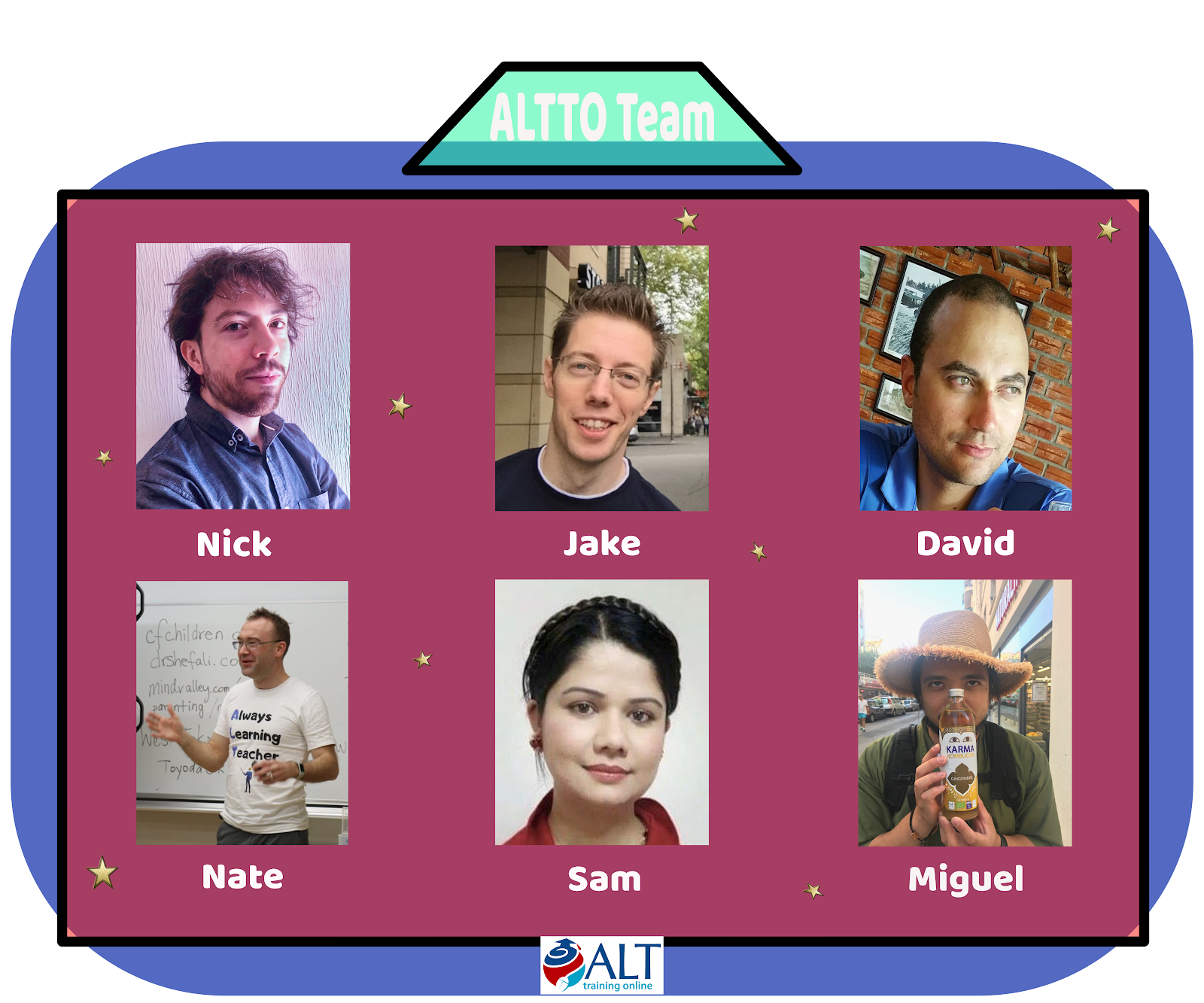
I've been learning to code and the ALTTO team is growing - so the site is getting a makeover!
New features are in place and we're launching two new modules: ‘Vocabulary’ by Dr David Coulson at Ritsumeikan University and ‘Speaking’ by Richard Graham from Genki English – but this is just the start.

David Hayter is as motivated as ever to keep the wide-ranging guest blogs coming – from Vietnam.

Jake (an established coder) is excelling on the ALTopedia resources site, keeping it maintained and arduously updating resources everyday.
We've new affiliations too, and are being advertised outside of Japan with our new partners, including JET (big thanks to all of them).
The big news……(drum roll)….. is the latest member of the ALTTO team, Nick. He's been working incredibly hard to prepare 'The Monthly Trainer'; an email newsletter that’s just the right length with content covering all areas of the ALT world: what's coming up in your schools, teaching tips, teaching English in English….. one of the major changes the Course of Studies schools are sent is requesting from April 2020 - the timing of The Monthly Trainer couldn't be more perfect.

We're working hard to launch the new site sometime in April – so check our Facebook group for the new link: https://www.facebook.com/groups/alttrainingonline/

Sign up right now for The Weekly Trainer, (first edition end of March 2020): https://mailchi.mp/4150701561cf/altto

Join us and make ALT lives better.
You’re still here - great. Read on...
You may know that online courses (in general) have a completion rate of around 10% according to most studies. You may have started one or a tonne of courses online yourself (I’m working my way through 4 at the moment). The ALTTO course/website is no different, although some modules are getting 100% completion rates, interest leaves some users with completion rates of around 20%.
We’ve listened to your feedback, re-reviewed the practice of learning online and have completely changed how the free ALT training course looks - how you the user can develop skills to use in the classroom, whatever your learning style.
It’s much more interactive now. Not just long texts to read with reflection questions - modules are made up of shorter units, a range of media is used, plus interactive features and various questions styles are used to make being an ALT much more enjoyable.

We’re updating the modules too. The three previous categories: Contextual, Teaching and Professional Development are being expanded!

We’re also taking away unpopular modules that didn’t seem to fit people’s interests. We’ve listened to and taken on board suggestions, and then searched far and wide for writers.
We know that the resulting new modules, and whole new course, will deliver exactly what you want and need to make not just make you more confident and better teachers, but also dramatically enhance the potential of your students. 
How would you make ALTTO and Altopedia better? Join the team and make it happen!

-          A note from ALT training online’s David Hayter


Never miss another blog again! Click here to sign-up for our newsletter, "The Monthly Trainer," to stay up to date with everything ALTTO has to offer.


If you have something 'ALT' to write about that hasn't been covered in these blogs, email me at alttoblog@gmail.com so we can work together and spread your story.

Don't have any ideas? We have a list of topics to write about that need a writer. Email in your interest to write and we can set you up. 

For upcoming blogs see the blogs tab here:  http://www.alttrainingonline.com/blog.html

Wednesday, June 20, 2018

EMI in Japan by Nicola Galloway

by Nicola Galloway,
The University of Edinburgh

Bio: Nicola Galloway is a lecturer in Education (TESOL) at the University of Edinburgh, where she teaches on the MSc TESOL, organising a course on Second Language Teaching Curriculum and Global Englishes Language Teaching.

Prior to taking up her role in Edinburgh, Nicola spent over 10 years in Japan, working in tertiary school systems. She was an ALT in Gunma Ken from 2001-2003 and the focus of her MSc TESOL dissertation was on evaluating the JET Programme in relation to Global Englishes.

She is co-author of Introducing Global Englishes (Routledge, 2015) and Global Englishes for Language Teaching (Cambridge University Press, 2018) and sole-author of a research monograph entitled Global Englishes and Change: Attitudes and Impact (Routledge, 2017). She has published Global Englishes-related research in System, ELT Journal, Journal of English as a Lingua Franca and Englishes in Practice.

She led a British Council ELT Research Award, which explored English Medium Instruction in China and Japan and is currently working on establishing a global online network on EMI and Global Englishes (Teaching English and teaching IN English in global contexts). She holds a PhD from the University of Southampton and her thesis looked at the influence of Global Englishes instruction on students’ attitudes towards the language they learn in Japan. 

Intro by Nathaniel Reed


We are very lucky to have a leading authority in global Englishes education write this guest blog for us about a topic that is increasingly relevant to our everyday teaching lives. Using English only in the classroom and teaching other subjects through English has been a goal released by the Japanese Ministry of Education (MEXT) incrementally. In 2014 the ‘English only in high schools’ reform was enacted (from the policy; English Education Reform Plan corresponding to globalisation, 2014). In 2020 all junior high school English classes are taught in English only too (some cities and prefectures from 2018).

We all, very likely, teach other subjects to a greater or lesser degree in our classes every weekday; if you do a little math, practice the past tense simply by asking questions about history, or ask about capital cities and world languages with interrogative questions, you are using English to teach other subjects - and this comes under CLIL (there is an entire module dedicated to this on the free ALT training course. Teaching other subjects is called English as a Medium of Instruction (EMI) and is becoming a cornerstone of English education in Japan.

Japan’s escalator system of education: ES, JHS, HS and university (rather than a gap year or starting work at 16) means that the percentage of students that go to high school (which is not compulsory) and university is quite high. By 2013 a third of Japan’s nearly 800 universities offered undergraduate EMI courses (a rise of 50% since 2005) (Brown, 2015). There are two main considerations for us when teaching in compulsory education and high schools: washback and teacher roles. You may well have read about the influence of ‘Washback’ in the dedicated blog and discovered the influence of tests on teaching and learning in Japanese schools. A summary of washback goes; education in Japan appears to be designed for students to pass tests. If tests don’t test speaking skills, those skills are not practiced in schools - this is called negative washback. However, with the advent of EMI in universities, we are now preparing our students to learn other subjects through the medium of English - positive washback. As English teachers, we powerfully influence the effect of positive washback and our student’s future academic life.

We know then that the roles of teachers are very much changing; we are teaching a lot more than just vocabulary and grammar. Speaking to other subject teachers in your schools is a starting point to put together materials for your classes; ask the social studies teacher what they’ve taught recently, then incorporate that content in your English class, as one example. By speaking to content teachers you can reinforce learning and provide valuable, meaningful English input.

From here, Dr Nicola Galloway brings us into the much wider picture of EMI and Global Englishes - enjoy!


Blog entry:


There has been a 1115% growth in English Medium Instruction (EMI) programs in Europe in 13 years (Wächter & Maiworm 2015), and rapid growth globally. It is both a global phenomenon and a growing field of research. In the field of higher education, institutions are increasingly turning to Englishisation as part of their internationalisation agendas. EMI courses and programmes are becoming the norm in many places where English has no official status, such as Japan. However, provision is fast out-pacing empirical research. This sparked my interest in investigating EMI in addition to my previous experience working in an EMI university in Japan, where I designed English for Academic Purposes (EAP) and English for Specific Purposes (ESP) courses for students enrolled on an EMI programme in international business. As I began researching the topic, I became concerned that despite an incredible growth in provision, there didn’t seem to be any monitoring systems, nor did universities have clear objectives or defined learning outcomes, making it difficult to assess whether such programmes were meeting their objectives. I was also interested in the impact this growth might have on the primary and secondary school sector in Japan and elsewhere.

EMI policies exist, but to my knowledge, universities have not developed clear learning outcomes. As such, it is difficult to measure their effectiveness. Research overall on the effectiveness of EMI, including the impact on students’ learning (of both content and English), staff experiences, university reputation, and different pedagogical approaches, is limited. In a recent British Council sponsored study, I explored EMI in higher education in Japan and China. It responded to Dearden’s (2014, p. 2) call for a “research-driven approach which consults key stakeholders at a national and international level” by providing insights on staff and student perceptions. In addition to providing insights into the driving forces behind, attitudes towards, and approaches to EMI, the study also raised questions as to whether approaching EMI monolingually is the best way forward, drawing on Global Englishes research showcasing how English functions as a global lingua franca.

I found that the Chinese institutions used much more of the student’s mother tongue within the classroom compared to the Japanese institutions that I visited, despite teachers reporting the contrary. It was also interesting that staff felt the use of the students’ mother tongue was a useful pedagogic tool, but were concerned when and how to use it. They also expressed concerns that students may develop a dependency on it. On the other hand, the students saw this as a sign of their teachers’ lack of English proficiency. This finding poses some interesting questions about the nature of EMI policy. Should it be a monolingual endeavour? Should we raise students’ awareness of the valuable use of their mother tongue, and also that English is now most commonly used in multilingual encounters? Should we train students to use English as a lingua franca with other international students and lecturers before entering an EMI university and, if so, how do we do this? I am currently analysing the data in more depth to investigate many of these topics.

One of the key driving forces behind monolingual ideology in EMI contexts is the belief that English-only in EMI will benefit English language development although, as mentioned they are not stated in clear objectives or learning outcomes. This is rather different to other content related language teaching models like Content and Language Integrated Language (CLIL). However, many universities do refer to the English language learning benefits of EMI, indicating that they think students will improve their English skills alongside their content knowledge. It is surprising, then, that despite the goal of improving students’ English skills, many do not offer suitable, and specifically subject-specific, language development support alongside EMI classes. There seems to be an assumption that just because a student has achieved a certain score on an English proficiency test, such as TOEIC, IELTS or TOEFL, they can function in EMI settings; they passed the test and, therefore, they must be capable of academic study in English. Some universities do offer structured language support, and I hope that the Teaching English and teaching IN English in global contexts network will provide a platform for such programmes to showcase good practice. Overall, more research is needed to measure language proficiency gain, particularly in institutions where this is the key driving force behind the policy. Rogier’s (2012) study in the UAE revealed that on average students gained a mere one half on an IELTS proficiency band over four years of EMI study, which can be achieved with 200 hours of study in a general English course (Rogier, 2012). In China, Hu, Li, & Lei (2014) found that EMI students made the same English language proficiency gains on two tests as those taking the comparative programme in Chinese at the same time as taking general English classes. Of course, there are studies which report more positive results, but there is a lack of studies to support the belief that EMI should be a monolingual endeavour to promote English language proficiency gains.

More research is also needed on how English is used in these programmes, particularly given the linguistic diversity of many cohorts of students. The switch to English in these settings does not necessarily mean a switch to ‘native’ English. Promoting an English-only policy in EMI is not reflective of how the language us used in these settings. Today, multilingualism, not monolingualism is the norm and it functions as a global lingua franca. In ‘international’ universities, many of the students are from diverse linguistic and cultural backgrounds and, therefore, students will use the language as a lingua franca. They will not only be communicating with ‘native’ English speakers, nor will they be communicating in ‘native’ English. More work is needed on EMI language policy.

There is an increasing literature reporting on the positive effects of using students’ mother tongue in the classroom (see Auerbach, 2000). Despite policies promoting the ‘English Only’ approach, Hall & Cook's (2012) study with 2,785 English teachers in 111 countries found that own language use is an established practice, noting that the need to maximise new language in the classroom does not preclude the use of the learners’ own language, as it may provide efficient shortcuts within the learning process, be more related to the learning processes the learners are using, or be more relevant to their external learning goals (2001, 2002)(p.282). As noted, my own study revealed interesting insights into staff and students’ perceptions of language use and I’d like to see more research on how languages are used in these programmes. There is a growing body of research in the field of translanguaging (Creese and Blackledge, 2010; Garcia and Li, 2014) showing the beneficial effects of moving across languages in communication. The spread of English as a global language has resulted in the emergence of a number of related fields of research, including English as an International Language (EIL), English as a Lingua Franca (ELF) and World Englishes (WE). These have been grouped together under the one umbrella term of Global Englishes (Galloway and Rose, 2015) in its exploration of the impact of the global spread of English on English users and learners. Global Englishes research is very relevant to those researching EMI, particularly given the calls for change to ELT practice to reflect the changing needs of English language learners in today’s globalised world. However, English-only ideologies remain strong; this is evident in the global EMI movement. In pre-university contexts in places like Japan, the ‘native’ speaker ideal also remains strong. I hope that practitioners in diverse contexts who recognise the changing needs of their students will be able to encourage a shift away from the ‘native’ English model. Intelligibility, not ‘native or near-nativeness’ is important to function in today’s globalised world, and it is about time that ELT caught up with how the language is used outside of the classroom. I am hopeful that research in both of these fields (GE and EMI) will grow. EMI contexts are emerging lingua franca settings and, as such, they are attractive research settings to look at policy and practice. With more research, universities may also be in a better place to devise clear objectives, learning outcomes and academic and linguistic support for their students.

Reference


Brown, H. (2016). English-medium Instruction in Japan: Discussing implications for language teaching. In P. Clements, A. Krause, & H. Brown (Eds.), Focus on the learner. Tokyo: JALT.

-          A note from ALT training online’s David Hayter


If you have something 'ALT' to write about that hasn't been covered in these blogs, email me at alttoblog@gmail.com so we can work together and spread your story.

Don't have any ideas? We have a list of topics to write about that need a writer. Email in your interest to write and we can set you up. 

For upcoming blogs see the blogs tab here:  http://www.alttrainingonline.com/blog.html