Showing posts with label community. Show all posts

Friday, March 20, 2020

End Of ALT Training Online? by Nathaniel Reed

by Nathaniel Reed

Bio: Nathaniel Reed started his ALT journey in 2014. He was mid writing a dissertation for an MA in Linguistics and it struck him that there was no training for this new job. Even low-level jobs have some kind of training to help you do the job effectively, and teachers are dealing with people’s lives.

These thoughts gave birth to ALT Training Online (ALTTO). 

Quickly realising that ALT pay is the same as when the current ALT system started in 1987, he knew that this training must be free. Thankfully there are a lot of helpful souls in the world, even the leading scholars on language education in Japan, so piece by piece it started to build - this blog will take you on the journey so we'll stop there for now.

With a house and two incredible children, every day is full of surprises and happiness for Nathaniel. We are all on a journey though, growing and evolving who we are on a daily basis.

Let today guide your thoughts in some way to be thankful. Who knows, you may even feel like joining the ALTTO team and improving the quality of what we’re doing. It would be great to hear from you.

Around 6 years have passed since the birth of ALT Training Online. After writing an MA dissertation on the roles of ALTs I couldn't help but let go of the burning question: why didn't I receive any teacher training (pre- or in-service?) when I got the ALT job?

With no coding or web development skills, but an ambition to provide high-quality, free training to thousands of ALTs, my mission began.
Alas, hundreds of dollars out of pocket and many aspects of the site needing an update I face a crossroads – redesign it completely or let the thousands of weekly users down. 
It's quite a size now, there’s a lot of content, so the work would take a while….
On an ALT's salary with a mortgage and two children, the decision should be quite simple, but I'm really struggling with the choice.

I’d hate my own children to go to school and get a low-quality education because the teacher wasn’t trained.

The emails ALTTO receives from individuals in need of help and all the positive comments we get have been on my mind for over a year…...
Unfortunately though, it's adios to ALTTO and ALTopedia….


Just kidding!
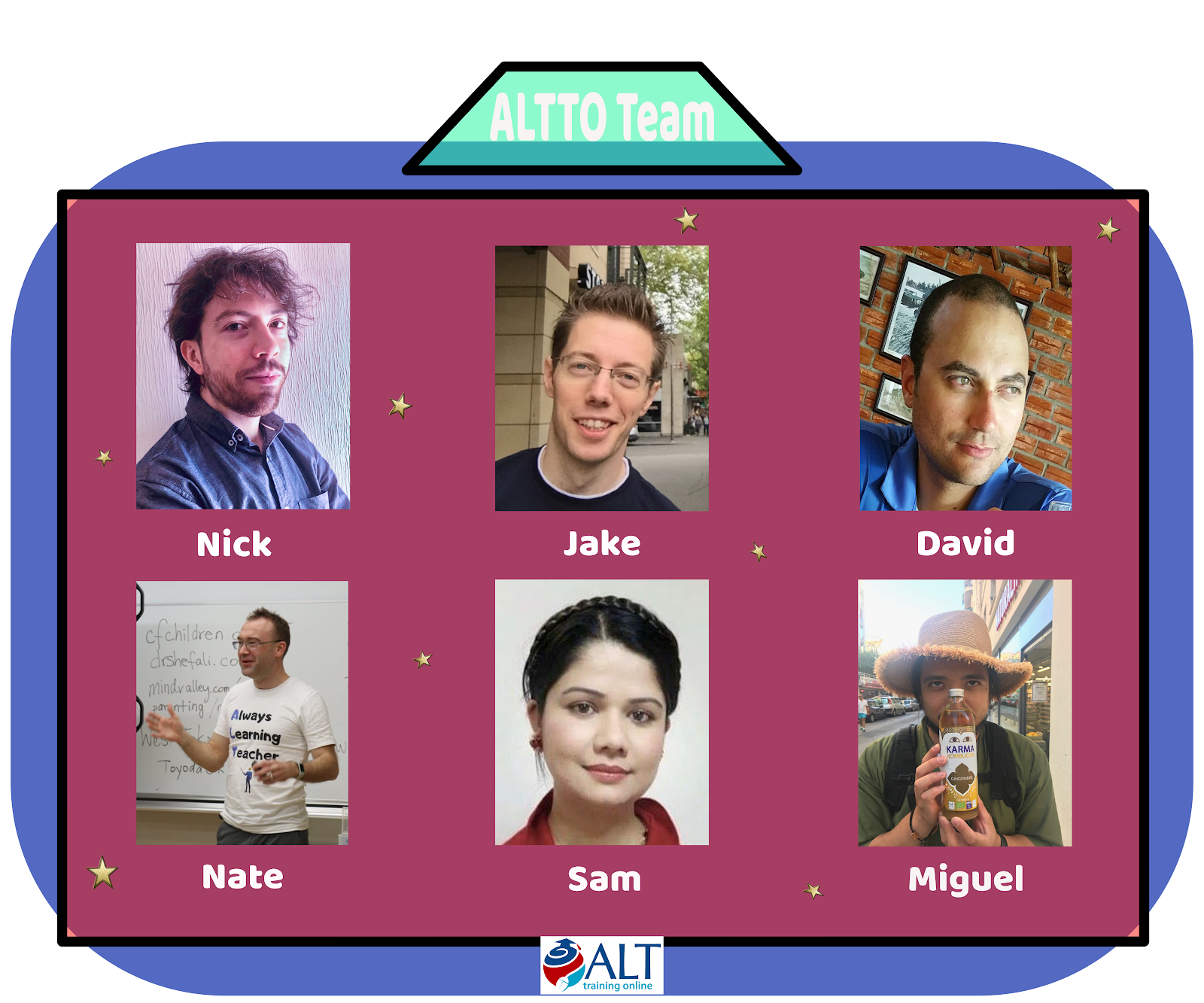
I've been learning to code and the ALTTO team is growing - so the site is getting a makeover!
New features are in place and we're launching two new modules: ‘Vocabulary’ by Dr David Coulson at Ritsumeikan University and ‘Speaking’ by Richard Graham from Genki English – but this is just the start.

David Hayter is as motivated as ever to keep the wide-ranging guest blogs coming – from Vietnam.

Jake (an established coder) is excelling on the ALTopedia resources site, keeping it maintained and arduously updating resources everyday.
We've new affiliations too, and are being advertised outside of Japan with our new partners, including JET (big thanks to all of them).
The big news……(drum roll)….. is the latest member of the ALTTO team, Nick. He's been working incredibly hard to prepare 'The Monthly Trainer'; an email newsletter that’s just the right length with content covering all areas of the ALT world: what's coming up in your schools, teaching tips, teaching English in English….. one of the major changes the Course of Studies schools are sent is requesting from April 2020 - the timing of The Monthly Trainer couldn't be more perfect.

We're working hard to launch the new site sometime in April – so check our Facebook group for the new link: https://www.facebook.com/groups/alttrainingonline/

Sign up right now for The Weekly Trainer, (first edition end of March 2020): https://mailchi.mp/4150701561cf/altto

Join us and make ALT lives better.
You’re still here - great. Read on...
You may know that online courses (in general) have a completion rate of around 10% according to most studies. You may have started one or a tonne of courses online yourself (I’m working my way through 4 at the moment). The ALTTO course/website is no different, although some modules are getting 100% completion rates, interest leaves some users with completion rates of around 20%.
We’ve listened to your feedback, re-reviewed the practice of learning online and have completely changed how the free ALT training course looks - how you the user can develop skills to use in the classroom, whatever your learning style.
It’s much more interactive now. Not just long texts to read with reflection questions - modules are made up of shorter units, a range of media is used, plus interactive features and various questions styles are used to make being an ALT much more enjoyable.

We’re updating the modules too. The three previous categories: Contextual, Teaching and Professional Development are being expanded!

We’re also taking away unpopular modules that didn’t seem to fit people’s interests. We’ve listened to and taken on board suggestions, and then searched far and wide for writers.
We know that the resulting new modules, and whole new course, will deliver exactly what you want and need to make not just make you more confident and better teachers, but also dramatically enhance the potential of your students. 
How would you make ALTTO and Altopedia better? Join the team and make it happen!

-          A note from ALT training online’s David Hayter


Never miss another blog again! Click here to sign-up for our newsletter, "The Monthly Trainer," to stay up to date with everything ALTTO has to offer.


If you have something 'ALT' to write about that hasn't been covered in these blogs, email me at alttoblog@gmail.com so we can work together and spread your story.

Don't have any ideas? We have a list of topics to write about that need a writer. Email in your interest to write and we can set you up. 

For upcoming blogs see the blogs tab here:  http://www.alttrainingonline.com/blog.html

Friday, April 19, 2019

Then And Now: Teaching In Japan by Neal Graham

by Neal Graham

Bio: Neal Graham is an ALT from Canada. He first worked in Japan over 20 years ago and later returned to teach here again.He has a BA in English and a CELTA. He also lived in Japan for 5 years in the mid-2000s working in the eikaiwa industry. Before becoming a city ALT, he taught at the university level in Japan.

Foreward: The following is a now-and-then comparison based on my experiences as an ALT. This is not meant to be an absolutely definitive tale of the way it was versus the way it currently is. Rather, it’s just a few casual observations based only on my experience and my situation. There are differences between my employment situations now and then that may have affected my perspective. For example, now I am a direct-hire municipal ALT whereas I was a prefectural-JET ALT many years ago. Other people will have completely different experiences.


I was a prefectural ALT with the JET Program 22 years ago. I stayed in Japan for 2 years and then returned to Canada. A while ago I came back to Japan and now I’m working as a direct-hire city ALT.

A lot has changed in Japanese schools in those two decades.

I could write about the many educational changes that have occurred, but I won’t. Instead, I’ll talk about a few non-educational changes that I’ve witnessed.

Compared to other countries Japan is still a very cash focused country, although this keeps changing bit by bit.

When I first worked as an ALT in the late 90s, I was paid in cash.

Once a month I was handed an envelope filled with money. This surprised me. The school had set up a bank account for me on my first day, and eventually they did change me over to a direct deposit system, but the cash payments continued for a quite a while. Certainly electronic deposits were possible in Japan at that time. I’m not sure if that happens anywhere anymore. My current employer has been depositing my salary directly into my bank account since I was hired.

I remember some Japanese teachers in the school were regularly paid in cash. Was this because they preferred to be paid in cash? Or was it a systematic quirk of my school?

To accommodate all the cash floating around the teachers’ room, a bank representative would come to our school once a week to take care of our banking needs.

Salaries could be deposited, spending money could be withdrawn and other banking transactions could be facilitated. I opened an account at that bank (Oddly, it was a different bank than the one where the school had opened my main account) so that I could do some banking from the convenience of the teachers’ room. Perhaps there are some banks somewhere still offering this service today, but I haven’t seen it.

Another change I’ve experienced involves ALT school assignments. When I was a prefectural ALT in the 90s, each ALT was assigned to only one school.

City ALTs that lived in that prefecture were shared between two Junior High schools. I spent every day at the same school. Every student had a lesson with me at least twice a week. I was able to get to know my fellow teachers and all the students very well. I participated in club activities and all the school events. I attended teachers’ meetings. I was treated as any other teacher at the school.

Now, as a direct hire city ALT, I work at many different schools – sometimes more than one in a single day.

It’s difficult to get to know the students very well. Although I’ve gotten to know some, I don’t know them in the same way as I was able to 22 years ago. I teach more than 1,400 students across my many schools so it’s difficult to know all their names. I understand the budgetary benefits of having one teacher go to many schools, but those may come at the expense of other social and cross-cultural benefits.

The most significant change I’ve seen has been around smoking.

When I was an ALT 2 decades ago, smoking was allowed in schools. There was a lounge area in the teachers’ room of my school where teachers would gather to smoke during the day. Many teachers also kept ashtrays on their desks. There was also smoking in the library and in many classrooms. I’m not sure whether or not it was officially permitted in the classrooms, but it happened.

Since the majority of teachers at my school were smokers, their smoking habits were completely accommodated.

Now, not only is smoking not permitted inside or on the grounds of the schools I go to, but it seems that only a small minority of teachers are even smokers. This is a big change that seemed unimaginable in the late 90s.

Clearly some of these changes are more significant than others. It’s nice to see schools change their attitudes towards smoking. I miss the personal touch that the weekly visits from the bank employee brought to banking. I always struggle to have good conversations with the ATM. I enjoyed working as an ALT 22 years ago and I’m happy to be back in Japan working an ALT again. I wonder what changes will occur in the future?

-          A note from ALT training online’s David Hayter


If you have something 'ALT' to write about that hasn't been covered in these blogs, email me at alttoblog@gmail.com so we can work together and spread your story.

Don't have any ideas? We have a list of topics to write about that need a writer. Email in your interest to write and we can set you up. 

For upcoming blogs see the blogs tab here:  http://www.alttrainingonline.com/blog.html

Sunday, January 20, 2019

Introducing ALTopedia by Jake Whiton

by Jake Whiton

Bio: Jake is an ALT (Assistant Language Teacher) working in Nagano prefecture. He has taught junior high school for 6 years as well as some high school classes.

He's from Washington state in the US. In his free time, he learns about web design, tries to get some exercise, and eats tonkatsu.


If there’s one thing an ALT needs, it’s ideas. ALTs are expected to bring fun, relevant, and accessible activities into their classes. Coming up with new games and activities on top of all of the day-to-day tasks of teaching can be a challenge - fortunately ALTopedia is here to help!

ALTopedia is a new site designed to help English teachers find activities tailored to their unique circumstances. I've worked hard to develop it in my spare time. There have been thousands of ALTs working in countless Japanese schools over several decades, and we think it would be to everyone’s benefit to have a place to gather their accumulated wisdom and ideas.

Whether it’s a warm-up game that requires very little explanation but energizes the class, or an in-depth speaking and writing activity to make a tricky grammar point relatable and interesting - we’re hoping ALTopedia will be the best place to find the ideas that have worked well for other teachers in the past.


You might be familiar with another site called Englipedia which was set up for the same purpose, and indeed, ALTopedia is its successor.


How is ALTopedia any different from its predecessor or several other sites which do something similar? I’ll start out by giving a brief history of Englipedia and how the new site has come about.

Englipedia was originally started in 2007 and grew to house over a thousand activities for elementary, junior high, and high school classes. I first came across the site when I was starting out in 2012.


It was recommended to me as the best source to find activities for class.


I remember that it was really helpful to be able to look up which page I was on in our school’s textbook and finding activities based on what that part of the textbook I was covering.

But I also remember that the site was a little creaky even back then. I would suddenly stumble across another corner of the site with a couple dozen activities that would have been really useful to me if I’d found them a month or two earlier.

I noticed that textbook listings or activities sometimes referred to previous versions of the textbook. I remember trying to contribute my own activities, but the submission form was broken. I noticed that no new warm-ups ever made their way into the listings, and new activities only trickled in in bursts.

It seemed like whoever was running the Englipedia site wasn’t keeping up with it by the time I’d found it.


A couple years later I met Al, another ALT here in Nagano. I was surprised to hear that he was the person running Englipedia. He wasn’t the original creator, but he was managing the site and looking for volunteers to help modernize it.

To hear him tell it, the site was originally built using some particular web software called Sharepoint. As the site grew larger and larger, it only became more difficult to manage.

If a user submitted a new activity, Al said it took him about 30 minutes to add it to the site. He had to copy and paste all of the information, upload files, and then go through the site and manually add links to it on any page that might be relevant. To make matters worse, the platform that the site was running on was being shut down, so there was no choice but to seriously rebuild and redesign it.

My understanding is that Al and the site’s original owner had different ideas about where to take the site in the future. Al decided it would be better to make a new site using the lessons he’d learned from managing Englipedia. I got in touch with him about a year ago to start outlining ideas for what would become ALTopedia, and we launched it in the spring of 2018.

The big advancement of ALTopedia is that it’s a modern web application designed to do its job right from the site’s code.


Englipedia, and other sites that function on a wiki-style model, can suffer from one big weakness as they grow larger - they were designed to be static web pages where users manually create links between them.

On a small site where one administrator can keep track of everything, this can be manageable, but a site the size of Englipedia ran into problems with discoverability.

Should this board game be linked under “Junior High School - General”? It uses mostly past tense questions, but also “can” - should it be linked under both grammar points? Maybe a teacher has discovered that the game works well for a small class of elementary-aged students, but there may not be any effective way to communicate this alongside dozens of other small tasks the site’s administrator needs to perform. And how much time is it going to take to rebuild textbook listings when they get revised?


ALTopedia addresses these issues of categorization and discoverability using tags.


You’ve probably seen them on sites like blogs. They’re similar to hashtags from different social media services. An activity has a big list of tags on it - things like its grammar point, the appropriate school level, which parts of learning it uses, and even if it applies to a particular textbook.

If you want to find more activities using that grammar point, you can click on the tag and go to a listing of all activities that use it. The listing will always be up to date, and since the site’s database was designed with them in mind, they’re updated automatically.

Submitting an activity is as simple as signing up and filling in a standard web form. There’s a list of grammar points and other information, which will become tags that help users find the activity.

We have a moderator check activities really quick to make sure that they aren’t spam, but all they have to do is click a button and it’s up on the site.


If you realized you forgot to add something or want to edit it, it’s no problem - you can revise your activities as many times as you want.


If you really like an activity (including your own) you can give it a thumbs up, which will make it show up higher in search results.

I’ve tried to design the site so it can be an effective vault for a huge number of activities, while still being easy to search and use.

The design is lightweight and works with mobile devices and tablets, so even if you’re stuck using your school’s ancient computer (or your smartphone), you can still use the site. I’m still coding and adding features to the site, so you can always drop a line and I’ll see what I can do.


Having operated the site for a little while, I’ve developed an appreciation for the large community that developed in Englipedia’s early days.


A lot of people went to considerable effort to share their activities and games with other teachers. In its last few years the community seemed to shrink a lot, but we’re hoping we can build something even better.

I’ve uploaded a lot of my activities that I’ve come up with over the years, but the site won’t be a great resource until it has contributions from a wide variety of people.

We’d be happy to see yours!


-          A note from ALT training online’s David Hayter


If you have something 'ALT' to write about that hasn't been covered in these blogs, email me at alttoblog@gmail.com so we can work together and spread your story.

Don't have any ideas? We have a list of topics to write about that need a writer. Email in your interest to write and we can set you up. 

For upcoming blogs see the blogs tab here:  http://www.alttrainingonline.com/blog.html